THE HOLIDAY GUEST

(It’s been my tradition to write a new poem each Christmas, so with apologies for my long delay in posting anything in the past several months, here is this year’s version.)

It may not quite yet be the night just before,

But Christmas is coming to our home once more.

We’ve fixed up each room that we have in the house

And lit all our candles, just me and my spouse.

The tree is all trimmed, and the mantle is full

With twelve stockings hanging (which looks pretty cool)

For family is coming from near and from far

They’ve followed their flight paths, if not quite the Star.

Still, right at the top of our holiday list,

We’ve tried to remember our One Special Guest.

For even in all of the seasonal mirth,

It’s still all about His incredible birth,

When glories of Heaven filled the skies and a cave

And a Savior was born on the night when God gave

To Mary and Joseph, a sweet little boy,

To all of mankind, an unstoppable Joy.

The world wasn’t ready; it just couldn’t see

The best present of all under anyone’s tree

Came not by delivery or bought in a store,

But from Heaven itself when it opened its door.

May we then give thanks for that bright shining morn

When into the darkness Christ Jesus was born.

Our lives ever changed, with a chance to start new

When God said to us, “Merry Christmas to you.”

Posted in Uncategorized | Tagged , | 8 Comments

Remembering Martin

His family called him “M.L.” when he was growing up, his wife called him “Martin” and he called himself am “ambivert,” that is a combination between an extrovert and an introvert. But what we should actually call him was simply a prophet. For like those heralds of old, Martin Luther King dared to speak up for God, and his message was one which has stood the test of time and proven its enduring worth.

Both by his words and the example of his life, for instance, he reminded us of the reality and power of what Reinhold Neibuhr, one of his principle influences, once called simply “collective evil.” His first brush with the ugliness of racism came when he was just five years old and the parents of his closest playmate, a white child who lived nearby, told him that their son and M.L. could no longer play together, just because he was black. Later on, he won an oratorical contest as a junior in high school, speaking on the Constitution and all of its promises, but then, simply because of the color of his skin, he had to stand on the bus all the way back to Atlanta making him, so he said, “the angriest I have ever been in my life.”

And still later, when white ministers failed to support him and the aims of the Montgomery bus boycott, he lamented over again the fact that it wasn’t just the children of darkness whom he had to fight, but that the contagion of hatred had even infected the children of light, as well. 

But Martin Luther King refused to give into those forces for as powerful as he understood evil to be in this world, he believed fervently and completely in an even greater force called love. In fact, armed with that understanding, he believed that a “minority of one honest man” could set into motion a moral revolution and so that’s just what he did. 

His eloquence was, of course, stunning, for Dr. King not only loved words but he understood how to use them with power and impact. Even in college, he impressed folks with his rhetoric, once replying to a simple inquiry as to how he was with the response, “Cogitating with cosmic creation, I surmise that my physical equilibrium is organically quiescent.” And later on, more substantially, he would enjoin the church to stop mouthing “pious irrelevancies and sanctimonious trivialities and start concerning itself with the creation of a world in which all barriers of caste and color are abolished.”

But then, of course, it was not mere rhetoric that Dr. King used to translate his faith into action. Instead, he used the power of love to convince others that true peace is not merely the absence of tension—it is the presence of justice. As Gandhi had done before him in India, his goal became not simply to defeat his enemies, but to redeem them through love so as to avoid a legacy of bitterness. “The chains of hatred must be cut,” he said, “for when it is broken then brotherhood can begin.”

All of which is why if we only come together to remember Dr. King and to celebrate his life without putting into practice the principles for which he gave that life that our services will be shallow and our words will be as nothing. For even faced with the bitter and acrimonious climate that has captured our country in recent years—a condition that has led many to conclude that we are hopelessly divided, both as a church and a culture–we should remember another observation which Dr. King once made, namely that “the is-ness of something does not imply the ought-ness of it.” 

Perhaps leaning upon the same God who raised up Martin Luther King, Jr., we too can learn the way of love and overcome those powers of darkness. Even if you’re not an ambivert.

(Originally appeared in a blog posted here in January 2013)

Posted in Uncategorized | Tagged , , , , | 5 Comments

The When of Christmas

It wasn’t in December

On a cold and frosty morn,

But probably in the springtime

When that blessed child was born.

Not in a barn out on a hill,

But maybe in a cave,

That Love descended to the earth

For all of us to save.

And whether there were three or more,

The Wise Men were not kings,

But seekers who could read the skies

And know of greater things.

Brave Joseph and dear Mary

Still not really all that old,

And yet they dared believe the words

Just as the angel told.

“Fear not,” he said,

“I bring you news that will be of great joy

For life itself can now be changed

Because of this one boy.”

And thus, no matter when it was

Or how it all took place

A Savior long ago was born

To save the human race.

Remember then on Christmas Day

Or on Epiphany

The miracle that happened

At our Lord’s Nativity.

But sing His praise and live His love

Give thanks through all the year

For while we still lived in our sin

Our God to us came here.

Posted in Uncategorized | Tagged , , | 9 Comments

For All the Saints

Saint Sam and Saint Christy.  Saint Betty and Saint Lou.  Saint Ruby and Saint J.D.  You’ve probably never heard of any of them or found their faces in a stained-glass window somewhere.  But they and countless others are saints indeed.  For according to the Bible, saints are not just those special persons who have been recognized or canonized by the Catholic Church.  Rather, the saints are simply all those who have been set apart for God’s purposes, which means all who follow Jesus Christ.

That’s why the apostle Paul addresses his letter to the Corinthians to all those “sanctified in Christ Jesus and called to be His holy people” (1 Corinthians 1.2).  It’s why that fisher of men, Peter, tells the believers scattered throughout the Roman provinces that they are a “chosen people, a royal priesthood, a holy nation,” indeed “God’s special possession,” (1 Peter 2.9), picking up a term used centuries before way back in Exodus 19.5 and Psalm 135.4.  

All of which means that if we’ve relegated saints simply to those impressive believers who lived long ago, we’ve missed the whole idea.  For you don’t even have to die to be called a saint; rather, you just have to live for the Lord.

The “poor man’s bishop” understood this, I think.  For before moving to Wakefield, William Walsham How may have had a lofty title—Bishop Suffragan of London—but he was actually the Anglican leader of the slum section of that great city, a position with no social prestige and a rather small salary indeed.  How, in turn, rode the buses rather than a private coach as he lived and worked with those who were his people.  It’s said that he had no purpose in life other than to help those around him, and he even turned down bishop postings in Manchester and Durham paying twice as much in order to stay in the slums.

The many hymns he wrote likewise spoke to common folks, following his belief that a “good hymn should be like a good prayer—simple, real, earnest, and reverent.”  And that was especially true for a song he wrote for All Saints Day in 1864, based upon the affirmation in the Apostles’ Creed about the communion of the saints.  Every time I sing it, in fact, I am almost brought to tears thinking about not just those “who from their labors rest,” but the saints around me right now who, like me, still may “feebly struggle” while those who have gone on glory shine.  For as How reminded us, “yet all are one in Thee, for all are Thine.”

On this All Saints Day, take a moment to say a prayer of thanksgiving not just for the holy ones who have gone before us into the church triumphant, but for those you know who are serving God still here in the church on earth.  For even when “the strife is fierce and the warfare long,” as Bishop How expressed it, let that distant triumph song yet steal on your ear and rejoice whenever “hearts are brave again and arms are strong.”    

Posted in Uncategorized | Tagged , , , , | 4 Comments

A Word About Chris

His name meant “Christ-bearer,” but it’s fair to say that he often failed miserably to live up to that calling.  For as is often the case for many of us, it was after his triumphant success that he began to forget the God whom he had originally set out to serve, seduced instead by the allure of riches, prestige, and power.   

To be sure, if ever a man was good at what he did, it was Christopher.  In the words of Peter Marshall, Jr. and David Manuel, he was ideally suited for exploration and at his best when in command of a ship, “facing the challenge of uncharted waters and the mysteries of undiscovered lands.”  

And he was likewise tenacious, pursuing for many years what he believed to be a God-given mission to carry the Light of Christ to those who had yet to hear His sweet name.  As he wrote in his journal, the words of Isaiah 49 summarized his calling: “Listen to me, o coastlands, and hearken, ye peoples from afar… I will make you as a light to the nations, that my salvation may reach the end of the earth.”

Thus, even when he was turned down by numerous royal houses in Europe, he continued to seek a sponsor for his expedition until finally finding two such individuals who had a fervent faith of their own.  For in appreciation for their victory over the invading Moors, King Ferdinand and Queen Isabella of Spain agreed to underwrite his journey as a way of showing gratitude to the Lord for His help.  Indeed, what better way could there be than to help discover new lands for the glory of God and to spread the gospel to the edges of the earth?

Early on the morning of August 3, 1492, Christopher Columbus thus knelt on the dock to receive communion before rowing out to the ship where his crew awaited.  And at first, it could not have gone any better.  But as they sailed farther and farther out into waters that no man had ever seen before, the crew began to lose confidence in their captain.  Those on the two other boats in the convoy, in fact, threatened outright mutiny until a tenuous deal was struck:  three days more, and if no land was sighted, they would turn back.

As Marshall and Manuel tell the story in The Light and the Glory, Columbus must have prayed then as he had never prayed before.  And incredibly enough, the first day the three ships set an amazing pace, sailing so fast that the men aboard became even more concerned.  The ships seemed almost to be racing one another, and even elected to sail into the darkness of the night.  Until at two a.m. with less than four hours remaining before the dawn of the third and final day, the cry rang out: “Tierra!  Tierra!”  Land!

Still thinking he had reached the Orient, Christopher Columbus had no idea, of course, that he had actually stumbled upon what he called San Salvador in the Bahamas.  When they landed and went ashore, however, led by Columbus, the first thing they did was to bow their heads and pray, that God’s holy Name might be proclaimed “in this second part of the earth.”  And when the shy inhabitants of the island came forth, Columbus recorded that he knew “that they were a people to be delivered and converted to our holy faith rather by love than by force.”

Unfortunately, of course, in successive encounters, his eyes tainted by the prospect of gold and riches, Columbus failed to remember that resolve.  And the tragic result was that in just a few years, one third of the 300,000 inhabitants of Hispaniola, where Columbus also visited, had died or been killed by fortune-hunters who came from Spain and elsewhere.  It’s understandable thus why some today might not wish to honor the Admiral of the Oceans whose exploration unfortunately opened up the New World not just to the gospel but to the greed and cruelty of others, too.

In the end, however, I rather believe that though Columbus may have turned away from God for a long while, God never turned away from Columbus.  When he died at the age of just 55, thus, just after receiving the sacraments once more, Christopher Columbus hopefully remembered the faithfulness of his Savior and of kneeling with the King and Queen of Spain after his first return from the Americas, where together they sang the praises of God with tears falling down their faces.  

And without excusing all the rest of the story, maybe that is what we might remember on this Columbus Day about the “Christ-bearer.”  For though we may not be sailing into vast unknown waters as that Genoese navigator long ago so courageously did, there are clearly troubled currents in the world today that challenge us, too.  And to all those around us, could it be that we have been called to boldly bear the name of Christ as well?

Posted in Uncategorized | Tagged , , , , | 3 Comments

“Christmas Eve Gift!”

It was a tradition within my mother’s family.  For growing up with her four sisters and their widowed mom on a cotton farm in Central Texas, when it came to extras, there simply weren’t many at all.  But every December 24 there was one special gift for whichever family member could wake up early and call out the words first:  “Christmas Eve Gift!”  It wasn’t a big item, of course—maybe just fruit and nuts– and sometimes, it simply meant that the winner could open their package a day earlier than all the others.  But it made life on the farm more fun and even the most modest Christmas more festive.  

So, in turn, my mom introduced the custom to our family, often coming into our room early on December 24 to catch my brother and myself off guard while still half asleep.  And I continued the custom with our kids as well, such that even now, our daughter, who has children of her own, will call me from England to try to say it before I can.  (She has a six-hour advantage on me.)

To be sure, the custom itself can be traced back to the early part of the 1800s, particularly in the southern United States. And Thomas Jefferson is recorded as having written in a letter on December 25, 1809, that his grandson was “at this moment running about with his cousins bawling out a ‘merry Christmas’ and ‘Christmas Eve gift!”

But then I suppose that God was the first one to ever make that cry when He sent His own Son into the world on that original Christmas morning.  For the gospels seem to tell us that, despite all of the Old Testament prophecies,  the Incarnation still came as surprise to almost everyone.  And when you strip away all of the cultural accoutrements, maybe it still does.

Here’s praying that each of you may be enabled to keep that same sense of wonder and surprise, no matter what else may happen on this winter’s day.  For what God did long ago in surprising the world really was the greatest Christmas Eve Gift of all.

Just don’t forget: I’ve already called it for this year.

Posted in Uncategorized | Tagged , , , , , | 11 Comments

Bethlehem is Broken

(As the Israel-Hamas war continues and the town of Bethlehem has “cancelled” Christmas celebrations this year, a poem that I wrote several years ago after visiting there and seeing the Wall of Separation between Israel and the West Bank seems more relevant than ever. I offer it as this year’s Advent poem, even as we continue to pray for the peace of Jerusalem and all those who live in the Land Between.)

Behind a wall of fear and shame

Near Rachel’s Tomb, it’s still the same

The “House of Bread” may be its’ name

But Beth Lehem is broken.

Among the clans of Israel

Too small to fight, and so it fell

To all who didn’t wish it well

Small Beth Lehem was broken.

And yet despite its size ‘twas here

Where love eternal did appear

When Heaven to Earth drew strangely near

And Word of God was spoken.

Not in a house, nor in an inn

But in a stable’s curious den

The pow’r of God came crashing in

As Word of God was spoken.

With only shepherds there to see

The dawning of that mystery,

Our hope for all eternity

Beyond all type and token.

And so despite what man may do,

Our barriers, both old and new,

We cannot stop what’s ever true

His Word cannot be broken.

For just as when King Herod ruled,

His jealous rages left unschooled,

The God Above cannot be fooled

His Promise has been spoken.

For peace will come again one day

And walls will fall when men will say

The child born here is still the way

To Bethlehem unbroken.

Posted in Uncategorized | Tagged , , , , | 5 Comments

Soldiers at the Wall

His father Elyada is said to have been the first Israeli Jew to move back into the Jewish quarter in the Old City of Jerusalem following its restoration to Israel in the fabled 1967 Six Day War.  And reflecting the resilience of beauty even in times of war, just a few days after that, Elyada opened an art gallery there on the old Roman Cardo, the original north-south street in ancient towns, now sunken well below the current landscape of the modern city.

 It’s no surprise thus that Udi Merioz, Elyada’s son, became an artist as well, with his talents recognized not just in Israel but worldwide.  For in addition to becoming the curator of the Israeli Prime Minister’s Art Collection, Udi created artwork for the bicentennial Independence Celebration in the United States which still hangs today in the White House.

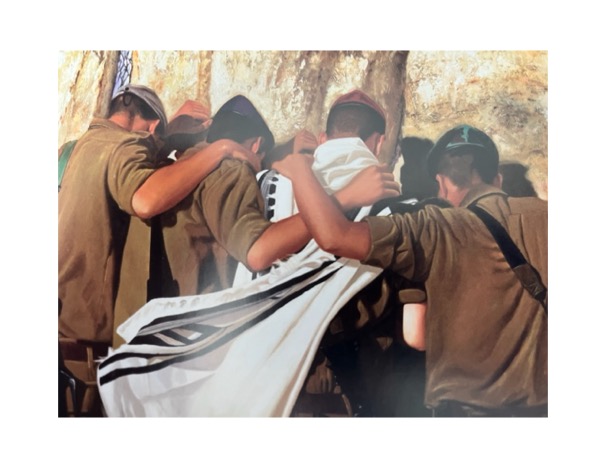
What is striking about his artwork, however, is the manner in which it is almost a “communicative language” in itself, as one has called it, embodying both the hope and courage that is a part of the Israeli national spirit.  His depiction of four young soldiers at the Western Wall in Jerusalem, for instance, shows them not only huddled fervently in prayer together, but with both their weapons and a prayer shawl.  And the point is that at times we are called not just to pray but to fight as well, not for personal motivations or gain, but rather for goals that go beyond our own lives.  

It reminds us, as well, of the passage from Zechariah 4.6 that Udi Merioz has attached to the print, “Not by might nor by power, but by My Spirit, says the LORD Almighty.”  For it is in that sense that the people of Israel are now combatting not simply the forces of another nation, but those who embody Evil and the ancient enemy of us all, the prince of this world, as well.

Such is not to say that the Palestinian people do not deserve our support and attention, for they do.  They have suffered long, and much and humanitarian efforts are desperately needed.  And it is noteworthy to add that though it is greatly underreported, the Israelis themselves are providing much of that even now.

But the terrorists who have overtaken Gaza are nothing short of satanic in their brutality and singular desire not just to establish a Palestinian homeland, but to utterly obliterate the nation of Israel—“from the River to the Sea”—and indiscriminately kill all those who are Jewish.  There is no moral equivalency involved in that equation, and those who argue for such do so out of either ignorance, misinformed bigotry, or pure malevolence.  

All of which is why the ancient admonition of Psalm 122 to “pray for the peace of Jerusalem” has never been more appropriate.  For the city whose name literally means “peaceful” is anything but that right now.  But God has a long history of faithfulness with Jerusalem and one day we are told that Christ will return to that very city to reign.

Until then, it is a time for faith and courage indeed, for “brave hearts again and strong arms,” as the hymnist once said.  For the Lord is looking for “watchmen on the walls” to call upon Him until God establishes Jerusalem and makes her the praise of the earth. (Isaiah 62.6)

And in that respect—if only with our prayers—perhaps all of us indeed have been called to be “Soldiers at the Wall.”

(Photo used by the kind permission of the artist. Copies of Udi Merioz’ work, “Soldiers at the Wall,” Artwork Serial Number 271, the most famous hand-signed print in Israel, are available through the gallery website at  www.BlueAndWhiteArt.com. )

Posted in Uncategorized | 9 Comments

A Long-Ago Word from Philly

It’s been quite a week in my hometown of Philadelphia, the City of Brotherly Love, so they call it.  Got some Greek words in the name, I guess, the kind that preachers like to use in sermons, you know.  Not sure just how much brotherly love there has been over at the State House, though.  For ever since that Virginia boy, Richard Henry Lee, read his resolution on June 7, things have been heating up.  Quite literally, I bet, for they’ve kept the windows closed so you can’t make out what they are saying.  But I bet it’s downright sweltering in that hall in more ways than one.  In fact, according to what I managed to find out, Lee resolved that—get this– “these United Colonies are, and of right ought to be, free and independent states, that they are absolved of all allegiance to the British Crown, and that all political connection between them and the State of Great Britain is, and ought to be, totally dissolved.”  Can you imagine that—independence!  

Oh, everybody knows it’s been coming for a while.  For King George has not exactly been responding to all of the list of grievances we’ve been sending over the Atlantic to him.  That’s why just over a year ago, in June 1775, that the Continental Congress established an army, put General Washington in charge of it—he’s a good man, though I think he’d rather be a farmer than a soldier sometimes.  But as he has said: “whenever my country calls upon me, I am ready to take my musket on my shoulder.”  

The king came back, of course, with a proclamation that we Americans were engaged in “open and avowed rebellion,” as he called it, and the Parliament even passed an act making all American vessels and cargoes subject to being seized by the Crown.  What’s more, just this past May we found out that King George has hired Germans to come fight here in America.  Germans!  Guess we shouldn’t be surprised—those Hanover kings were Germans to begin with.  But it’s just going to make things worse, I think.  For nobody likes a mercenary, a gun for hire.

Of course, to be fair, earlier this year, Tom Paine also stirred it up a bit with his little book, Common Sense—it sold by the thousands.  And Patrick Henry—he gave a speech last year in Virginia that was an appeal to God and an appeal to arms.  “Three million people,” he said, “armed in the holy cause of liberty and in such a country, are invincible by any force which our enemy sends against us.  For we shall not fight alone.  God presides over the destinies of nations and will raise up friends for us.  The battle is not to the strong alone; it is to the vigilant, the active, and the brave.” And then he summed it all up by asking, “Is life so dear, or peace so sweet, as to be purchased at the price of chains and slavery?  Forbid it, almighty God!  I know not what course others may take, but as for me, give me liberty or give me death!”

And with words like those, well, maybe that’s why eight colonies decided to support independence.  Only right after old Richard Henry Lee came riding back from Virginia with his motion, which John Adams was quick to second, the Congress postponed the vote and then took three weeks in recess so that everybody could go home and sound out the will of their neighbors.

And in the meantime, they appointed a Committee of Five to work on a draft to tell the whole world what our case for independence really is.  John Adams of Massachusetts, of course, was one of the five—that man does love to talk.  Roger Sherman of Connecticut was also from New England.  Then there were two from the middle colonies, old Ben Franklin from Pennsylvania—God bless ‘em; he really is old—70, I think, the oldest man in the room, that’s for sure—and Robert Livingston from New York.  Then they wanted to appoint Richard Henry Lee from the South, but he was already working on the Articles of Confederation and thought it was too much to try to do both; plus, his wife fell ill and he had to go home prematurely.  So, they picked another young Virginian to take his place, a fellow named Thomas Jefferson.

Only here was the thing:  Jefferson didn’t want to do it—he wanted John Adams to write it.  Said he wouldn’t do it, in fact.  And when Adams said he had to, Jefferson answered saying, “give me some solid reasons why.”  To which Adams said, “first off, you’re from Virginia and a Virginian ought to be at the head of this.”  “Second,” Adams said, “I am obnoxious, suspected and unpopular.  You are very much otherwise.”  “Then third, you can write ten times better than I can.”  So, Jefferson finally agreed and did most of the writing, with Franklin and Adams making the corrections.  Took 17 days to hammer it out but I have to say that Jefferson does indeed have a way with words.  For listen to how he started, in fact: “We hold these truths to be self-evident,” he wrote, “that all men are created equal, that they are endowed by their Creator with certain unalienable rights, that among these are life, liberty and the pursuit of happiness.”  Did you catch that?  “All men (and women, too, for that matter) are created equal.  Nobody in the world has ever actually believed that, but we do.  For there are some rights that people ought to have not because somebody has granted them those rights, but because God Himself did when He lovingly and intentionally created us all to reflect His glory on this earth.

The Congress came back just a few days ago on July 1 and on July 2, they adopted Lee’s resolution for independence by a vote of 12 to 0 to 1—New York abstained—they tend to do that a lot in the Congress.  And immediately afterwards, they started to consider the Declaration that the writing committee put forth.  I hear that General Washington sent a letter to his wife on the 3rd that said that “in a few days you will see a Declaration setting forth the causes which have impelled us to this mighty revolution, and the reasons which will justify it in the sight of God.  I am fully aware of the toil and blood and treasure what it will cost to maintain this declaration and support and defend these states; [but], through all the gloom, I can see the rays of ravishing light and glory.”

And in the end, I think the General was right about the light and glory.  For even though I’m not sure how much Christianity Thomas Jefferson has in him, it’s pretty clear that the premise on which his Declaration stands–or falls, I suppose–is a religious appeal.  Because again, there’s only one authority that actually matters and can give it validity and truth, and that’s an appeal to “the Supreme Judge of the world,” words that the Congress insisted Jefferson add to his document.  Because who else do you suppose could have made those self-evident truths so evident?  Only the Lord who already put them in His Word.  And who are we going to have to depend on when things really begin to heat up?  Only Divine Providence, friends.  For, you see, this nation really was founded as a city on a hill, a great experiment if you will.  And without God, it’s just nonsense to think that we’ll ever really be free at all.  

They debated it for a good while.  John Dickinson of Pennsylvania spoke eloquently against it.  Adams waited for someone else, someone less obnoxious than himself, to rise to answer, but no one did and so Adams got up and he spoke with such power and conviction that it stunned everyone.  “Before God, I believe the hour has come,” he said. “My judgment approves this measure, and my whole heart is in it.  All that I have, and all that I am, and all that I hope in this life, I am now ready to stake upon it.  And I leave off as I began, that live or die, survive or perish, I am for the Declaration.  It is my living sentiment and by the blessing of God it shall be my dying sentiment.  Independence now, and independence forever!”  Nobody spoke after that, until the door swung open and in came the Reverend John Witherspoon—a Presbyterian, I think, you know, God’s Chosen Frozen—he’s the head of the New Jersey delegation, and he announced that his state was ready to vote for independence.  Only Pennsylvania and South Carolina still voted no; New York abstained, and Delaware was split, one delegate for and one against.  

It had to be unanimous, so they decided to come back the next day and try again.  To resolve the Delaware deadlock, they sent word to Dover, the capital of that colony, to fetch their third delegate, Caesar Rodney.  Rodney had had to go home on urgent business, but when he got the word at two in the morning that debate would resume in less than seven hours, he got on his horse and galloped off in a pitch-black stormy night, 89 miles to get here to Philadelphia in horrible conditions, with roads flooded out and no change of horses until dawn.  He arrived just as the final vote was being taken, barely able to speak.  They had to practically carry the man into the room. But he voted for independence, breaking the Delaware deadlock, and the other delegations followed suite, all except for New York, which abstained.  So, they passed that Declaration twelve to nothing, and after announcing the vote, everybody was quiet as the magnitude of what they had just down fell over them.  Some wept.  Some, like Reverend Witherspoon, said a prayer.  And then John Hancock, the president of the Congress, broke the silence by saying, “Gentlemen, the price on my head has just been doubled!”  Ben Franklin likewise told the others that they must “all hang together now, or, most assuredly, they will all hang separately.”Everybody laughed a little and then Samuel Adams stood up and this is what he said: “We have this day restored the Sovereign, to Whom alone men out to be obedient.  He reigns in Heaven and… from the rising to the setting sun, may His Kingdom come.”  No king but Jesus, my friends, no king but Jesus.

I hear John Hancock plans to be the first one to sign it when they get it back from the printers in a couple of weeks.  He says he going to put his name in big letters just below the center, large enough so that old King George can “read it without his glasses.”  Everybody then will sign it in geographical order, putting their names on that parchment in the same arrangement as their states are, with New Hampshire, the northernmost state, on the top, and Georgia, the southernmost, down below.  

But, you know, in the end that Declaration was not really written just for the 13 American colonies.  For if you read it closely, what you will discover is that it was written for the world.  Because I have to think our country has been given a mission by God, to carry freedom everywhere.  Indeed, we will never be truly or safely be free until all people on earth enjoy that same freedom.  It’s a pretty big task.  But then we have a pretty big God, as well. Maybe that’s why the good book tells us that “blessed is the nation, the people, the goyim in Hebrew, whose God is the LORD, that is, YHWH.” Matthew Henry once put it this way.  He said that the hearts of such a people, as well as their times, are all in God’s hand.  All the powers we have depend on Him, and they’re of no account, of no avail at all without Him.  But if we make God’s favor sure towards us, then we need not fear whatever is against us, for God’s watchful eye is over all those who have a believing hope in his mercy.  And then Henry said this, that “there is no flying from God but by flying to Him.”

I guess in the end, therefore, our job is just to depend upon God and look to Him as a nation, and then step up and do what we can to keep this democracy working.  In fact, it might help if everybody simply said the same words that those who signed the Declaration over at the statehouse agreed to.  You can say them with me right now if you like: “Appealing to the Supreme Judge of the world, for the rectitude of our intentions, with firm reliance on the protection of Divine Providence, we mutually pledge to each other our lives, our fortunes, and our sacred honor.”

My, what a difference that can make if we truly believe it. For as Benjamin Franklin said, “the longer I live, the more convincing proofs I see of this truth—that God governs in the affairs of men.  And if a sparrow cannot fall to the ground without His notice, is it probable that an empire can rise without His aid?”  That’s the news from Philly on this Independence weekend, where there’s no king but Jesus, and all of God’s children are strong and brave. May it be the word from wherever you are as well.

(Adopted from the message shared on July 3, 2022, at Christ Church Sugar Land. To see the entire service, done in the style of a radio program, visit the sermon archives at christchurchsl.org/videos/)

Posted in Uncategorized | 8 Comments

Borrowing the Crown

It will be a spectacle on Saturday, to be sure.  For when Charles III–perhaps the longest man ever to wait for his real job to finally kick in–is crowned in Westminster Abbey the symbolism will more than outweigh the sentiments.  What’s more, those in Christian circles will instantly recognize many of the words that will be said.

When a fourteen-year-old chorister welcomes the king, for instance, Charles will respond by saying, “In His name and after His example, I come not to be served but to serve.”

When the moderator of the Church of Scotland presents a red-leather bound bible to the sovereign—presumably a King James Version, just to keep it in the family—Charles will symbolically acknowledge a source of truth greater than any other.

When the Prime Minister—a Hindu—reads from Colossians 1.9-17, He will remind those assembled that in Christ “all things were created, things in Heaven and on earth, visible and invisible, whether thrones or powers or rules or authorities,” for “He is before all things and in Him all things hold together.”

Similarly, Charles will be anointed with oil harvested from two groves from the Mount of Olives, pressed just outside Bethlehem, and consecrated by both the Patriarch of Jerusalem and the Anglican Archbishop from there.

And then when the crimson Robe of State is put upon Charles, who will be wearing a simple white shirt befitting one who comes before God as a servant, the Archbishop of Canterbury will say: “Receive this Robe.  May the Lord clothe you with the robe of righteousness and with the garments of salvation.”

All of which is appropriate indeed for stepping into a role in which he will be not simply the British Head of State, but the Supreme Governor of the Church of England and, according to the original words at least, the “Defender of the Faith,” a la Jude 3, not simply a defender of more generic faith as Charles himself has suggested the title should read.

What appears to be missing, however, are the words which long ago a different Archbishop of Canterbury pronounced when he laid the crown upon the head of Charles’ mother, Queen Elizabeth II: “I give thee, o sovereign lady, this crown to wear until He who reserves the right to wear it shall return.”

And those would seem to be the most important words of all.  For even with an English son-in-law and grandchildren, and a daughter who just this week received her dual citizenship in England, all the pomp and circumstance in the world should not cloud us to one undeniable truth:  Supreme sovereignty lies with God alone.  So, if we have been granted a position in which to exercise authority over others ourselves—such as a monarch, a president, a teacher, a boss, a bishop, or even a parent—we do so only on His behalf in this world.

Or to put it another way, all crowns on this earth are only borrowed. Whether those words are said or not on Saturday, here’s hoping that all of us, including the new King and Queen of England, may remember that.

Posted in Uncategorized | Tagged , | 11 Comments