COVID Contemplations (April 1) – “No Fooling”

No one knows for sure, of course, and the very nature of the day would seem to encourage ridiculous explanations.  But the most convincing historical evidence suggests that it began in France (insert joke here) in the time of King Charles IX.  For in 1564, Charles proclaimed that New Year’s Day which had been celebrated on March 25, the advent of spring, be moved back to January 1 to align with the more accurate Gregorian calendar.  Many Frenchmen, however, resisted the change and others simply forgot about it.  So the partying and exchanging of gifts continued throughout that week ending on April 1.

In turn, jokers made fun of those attached to the old New Year’s Day by sending them foolish gifts and invitations to nonexistent parties.  And whoever ending up being the target of those jokes was then known as a poisson d’Avril, or “April fish” in recognition of the Zodiac sign for that season, Pisces.  Centuries later, even Napolean, when he married his second wife on April 1, 1810, was nicknamed “April Fish.”

And eventually the custom spread across the channel to England, where on April 1, 1698, hundreds of Londoners were tricked into coming to see “the lions washed.”  But the best April Fools pranks have probably come from newscasters and newspapers.  The BBC, for instance, once tricked the whole nation with their video report of spaghetti growing on trees in Switzerland.  And in America, Taco Bell outraged many with their announcement on an April 1 that they had bought the Liberty Bell which would now be known as the “Taco Liberty Bell.” Beginning in 2000, Google also joined in the fun over the years with reports of a plan for human settlement of Mars, a mic-drop button on Gmail, and “Google Translate for Animals.”

This year, however, Google has announced it will resist any hoaxes out of deference to all those fighting the coronavirus pandemic.  And though I understand and respect that, in some ways it’s a shame.  For in times of disease, laughter is indeed still a good medicine, as Proverbs 17 reminds us.  Science tells us, in fact, that when you start to laugh, it not only stimulates the heart, lungs, and muscles, increasing the release of endorphins, it can also decrease your heart rate and blood pressure, help your circulation, and even improve your immune system as well as your mood.

With appropriate sensitivity to others, thus, take this April Fools’ Day to laugh a little.  Play nice.  But do play at least some.  It’s how we’ll get through days like these.

No fooling.


Posted in Uncategorized | Leave a comment

COVID Contemplations (March 31) – “Feeling Like Frodo?”

His name comes from an Old English word meaning “wise by experience.”  But it’s pretty clear that if he had been given a choice in the matter, that the little guy would probably have preferred to pass on many of the experiences which came his way.  After all, he never even wanted to leave his comfortable shire and travel across those Misty Mountains and dark forests in the first place.  And after being pursued by Black Riders, waylaid by enchanted trees, stabbed with a Morgul blade, and then attacked by an army of Orcs, all while on an impossible quest to destroy the powerful “One ring to them all,” it’s understandable why for all of his courage and selflessness, the hobbit was just about overwhelmed by his circumstances.

“I wish it need not have happened in my time,” says Frodo despondently to the wizard who has guided him in his journey.

To which Gandalf replies, “So do I, and so do all who live to see such times.  But that is not for them to decide.  All we have to decide is what to do with the time that is given us.”

And it would seem that no less than those described by J.R.R. Tolkein in his classic work, The Fellowship of the Rings, the times that have been given to us right now are complex and challenging ones as well.  Even as we start a new month, in fact, we do so knowing that the social distancing guidelines and restrictions on normal life will continue until the very end of April.  For the numbers of those impacted by the pandemic have not yet even reached their apex.

Beyond the incalculable loss of those who will become sick and even die from the virus now upon us, however, are also the backstories of individuals whose futures have otherwise been irretrievably altered too… of high school and college seniors robbed of a final semester… of athletes deferred from championships and chances to shine… of weddings postponed and even funerals delayed… and of a myriad of other changes that no one could ever have foreseen when the year began just three months ago.

Through it all, though, there is yet the voice of the One who has “Ever Been and Ever Shall Be,” who exists beyond the dimension of time because it too is His very creation.  And He has promised not only never to leave or forsake us, but to one day make all things right, even wiping every tear from our eyes (Revelation 21.4).

The reality that is now sinking upon us like a coastal fog is that we can’t change the times that have been given to us anymore than Frodo could.  But as Gandalf reminded his friend, we can decide what to do with the time that is before us, to lose it in grumbling and resentment, or to redeem it–literally in Ephesians 5, to “buy it up”– for our good and for the good of others.

Nobody chose any of this, it’s true.  But could it be that we were actually made for such times as these?


Posted in Uncategorized | 5 Comments

COVID Contemplations (March 30) – “Is E-Eucharist Okay?”

It’s not exactly a hot button issue for many folks, I know.  But for theological purists it’s a valid question all the same.  For after all, it is by definition a communal meal.  So is it possible to offer Holy Communion with integrity when the community is not actually present?  Or to put it another way, if the sacrament of the Lord’s Supper is about breaking bread together, can it really be shared when everyone is instead scattered?

And at least my answer is yes.  For when Jesus told us to eat the bread and drink the juice or wine in remembrance of Him whenever we do so, I think He meant that just as taking bread and drink is a daily occurrence in all of our lives, so too He desires to be in our everydayness as well.  And especially when our circumstances are stressed as at present, we have a need to experience His closeness now more than ever.

In that sense, the question of whether or not Holy Communion can be shared digitally via livestream when the congregation is diffused across numerous households, and even around the world, is more of a pastoral issue than a strictly theological one, I think.  For Jesus Himself made it plain that the exercise of His power is not confined to His physical presence at all.

In Mark 8, for example, we read that the Lord honored the faith of a Syro-Phoenician mother by exorcising a demon or impure spirit from her daughter without ever even seeing the girl.  And similarly, when a Roman centurion came to Jesus asking for his servant to be healed the soldier told the Master that He did not need to come to his house as he was not worthy.  Instead, the man asked, “just say the word and my servant will be healed” (Matthew 8.8) and when Jesus did so, his servant, so the gospel tells us, was healed “at that moment.”

I believe thus that we can ask the Spirit of God to come to all of our homes and use whatever bread and juice we may have gathered for a moment of drawing close to Him and each other as we corporately remember all that Jesus has done for us. Even while I respect that others may feel differently, we will continue to offer Holy Communion as we did Sunday during our livestream service on a regular basis until the glorious day when we can all assemble in person once more.

For in the end, it’s about connecting to the One who has invited us not just to His table but has blessed us all by coming to ours as well.

Posted in Uncategorized | 5 Comments

COVID Contemplations (March 27) – “Home-School Daze”

I suspect we are all pretty ready for them to receive a well-deserved raise.  For especially if you’ve been homeschooling your children during this stay-put season, you no doubt have discovered a newfound admiration for teachers who deal with our kids every day.  You may even be able to sympathize a little with the woman who was seen out early one morning scraping the “My Kid Is a Terrific Student” sticker off of their minivan.  For I’m just guessing that the first week of homeschooling didn’t go all that well in her house.

On the other hand, what an amazing opportunity this is for parents and children to step into each other’s worlds, with dads and moms working at home while simultaneously trying to keep their kids’ learning curves going upward.  For despite the importance of public and private education, long ago the scriptures commanded parents and grandparents—as well as others blessed to be a part of children’s lives–to be the ones to teach the words of God to our children and talk of them all the time. (Deuteronomy 6.6-7) Likewise, the wisest man who ever lived, Solomon, reminded us in Proverbs 22.6 that we should “start children off on the way they should go and even when they are old they will not turn from it.” (Unfortunately, there’s no guarantee for those “middle years.”)

And all of this is because, as the psalmist reminded us, children are indeed a “heritage from the Lord, offspring a reward from Him.” (Psalm 127.3) In turn, it’s the job of parents and loved ones to prepare their children for the day when they will leave home and enter into that wider world beyond.  And the biggest way in which our kids will learn is simply by watching their elders model what it means to be responsible to others as well as to the Lord.

So if you want to teach your children how to treat others kindly, for example, then let them see you write a thank you note for a gift, or step across the street to help a neighbor.  What’s more, let them see the why behind what you are doing and encourage them to ask questions.  And get used to the idea that you’re probably going to have to re-teach a skill far more than once.

To be sure, there’s probably a reason why James 3.1 tells us that “not many of you should become teachers,” for the truth is, it’s pretty hard work indeed.  But at least for now, that’s the role God seems to be giving to many during our stay-at-home shutdowns, and as has often been said, God does not so much call the equipped as He equips the called.  Perhaps one gift of the coronavirus is to be reminded that all along, thus, it’s been our job to teach our children about who God is and what it means to follow Him as disciples in this world.

And in the meantime, if math and science homework are eating your lunch, hang on, friends.  For the public schools, at least in our area, are starting back with mandatory on-line classes next week for those of all ages.

We really should be paying those teachers more, though, shouldn’t we?

Posted in Uncategorized | 5 Comments

COVID Contemplations (March 26) – “Covid Christianity”

You can read about it in the history books, though I doubt that any written words could ever really convey its terror.  For when the bubonic plague first raised its ugly head in Sicily in 1347, not only were there few medicines to treat it, it was so lethal that some patients went to bed feeling okay and died before morning.  Likewise, as historian Mark Galli has shared, some doctors caught the illness at a patient’s bedside and passed away before the patient.  In some places the mortality rate was as high as ninety percent, and as the “Black Death” passed through medieval Europe, in fact, it is estimated that 20 million people succumbed to it.  Or to put it another way, between 1347 to 1350, “one third of the world died.”

It’s no wonder thus that people shut themselves up in their own homes, with few daring to help or visit the sick.  Still, in the midst of the greatest catastrophe in human history, there were some rather incredible examples of Christian charity.  One French chronicler, for instance, cited by Galli, recorded that the nuns in the city hospital, “having no fear of death, tended the sick with all sweetness and humility.”  And when they too fell ill, others simply replaced them until almost all of had died as well.

What’s more, when another wave of that plague came back to Italy in 1374, a woman who had been born in Sienna, Italy, during the first outbreak, likewise stayed to nurse the ill and bury the dead.  She was, in the words of an earlier historian, Philip Schaff, “indefatigable by day and night,” performing the most distressing nursing chores to patients who were not just incurably ill but in pain and often abusive.

But in that regard, Caterina di Giacomo di Benincasa, or St. Catherine of Sienna (for whom a church in my own neighborhood is named) was simply following the example of countless believers before her.  When a terrible plague passed through the Roman world in the third century, for instance, a bishop named Cyprian told his flock not simply to grieve for the victims (as they were now in heaven) but to redouble their efforts to care for the living, heedless of the danger.  Later on, it was Christians who established the first hospitals in Europe as sanitary places providing care during numerous times of disease.  And as Christians did good not just to their own, but to all around them, it was not only noted by others (even if begrudgingly), but it’s estimated that the death rates in cities with Christian communities may have been cut in half of that of other places.

Fortunately, as challenging as it has been across the world, the current coronavirus has not risen to those dramatic mortality levels.  But the call for followers of Jesus to continue to step into the breach remains the same, I think, by finding ways to give and serve, and by following quarantine guidelines meant to prevent the spread of the disease any further, including moving to livestream or on-line worship services only.

Or, in short, as has long been a part of our faith, this is not a time for the church to seek to save its own life, but to follow the Lord in giving our lives over to save others.  Even if that means we give up “church” as we’ve all come to know it for a while.

Posted in Uncategorized | 4 Comments

COVID Contemplations (March 25) – “Chick-Fil-Aity”

Even for someone on a low-sodium diet, you can never really get enough of it, which is probably why it is one of the key ingredients on the menu.  For a twelve-count of nuggets is said to contain some 1460 milligrams of sodium, or roughly 61% of your daily needs when it comes to salt intake.  It’s totally worth it, however, as most folks would agree that the nuggets at Chick Fil-A are uniformly delicious, enticing both to kids and all the rest of us.

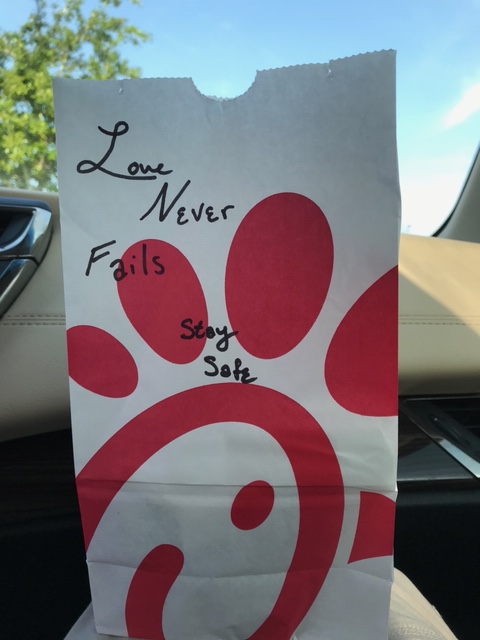
There’s another kind of salt at those restaurants, however, which is equally appealing.  For what is likewise ubiquitous no matter which store you stop in–or in these days, drive through–the response you will get to your order is inevitably always, “My pleasure.”  And even more impressive, it seems like those teenagers working there actually mean it.  (One of them took the time, in fact, to write a personal message on our take-out bag.) For along with whatever other business mantras they have may have adopted, the franchise owners of Chick Fil-A have made a decision to consciously act on Christian principles as a business.

And in that sense, they’ve taken to heart the words of St. Paul in Colossians 4.6 to “let your conversation (literally, your logos or word) be always full of grace, seasoned with salt, so that you may know how to answer everyone.”  It’s an odd turn of words, to be sure, but it points us towards an understanding of the function of salt itself—both to preserve and to flavor whatever it is sprinkled upon, that is, to keep it from spoiling and to enhance its taste.

All of which is a goal worth pursuing in our present stressful season of separation, social distancing and shortages.  For if all those following Jesus make a conscious decision to check our own selfishness, inhibit our impatience, ratchet back our hasty retorts, and speak only with grace to all, though we may not be able to bring down any individual’s fever, we will be able to lower the temperature of the interactions around us and even short-circuit some of the snarkiness that seems to have seeped into this world.

What’s more, when we actually put others first then it will indeed be our pleasure to serve them, whatever their needs might be.  More significantly, Revelation 4.11 reminds us that it is for God’s pleasure that we exist and were created. And as John Piper has observed, God is most glorified in us when we are most satisfied in Him.

In these days ahead, thus, as the inconvenience of impoundment increases for many, may the conversation of each of us indeed be seasoned with salt, preserving what’s important, and flavoring all things with the grace of God.

After all, isn’t that what the people of God—or to paraphrase a theological term– the chick fil-aity—are supposed to be about?


Posted in Uncategorized | 5 Comments

COVID Contemplations (March 24) – “Give Me That New-Tech Religion”

To be candid, we’ve seldom been on the forefront of technological innovation.  For there’s something about the church that seems to find its comfort zone more in the past than in the present sometimes.  More than half a millennium ago, for instance, the citizens of Paris were said to have loudly complained about a “new innovation” in Notre Dame that seemed out of place indeed, marring the cathedral’s native beauty and requiring far too much maintenance and labor to justify its installation.

It took a while for folks to thus accept the addition of the Grand Organ with its 8000 pipes and no doubt, some of the older folks probably complained about it initially as simply being “too loud” for worship.  What’s more, it’s said that during the French Revolution, the only reason that organ survived being vandalized and its pipes melted down to make bullets was because the organist played “La Marseillaise” repeatedly for the revolutionaries!

So likewise, when it has come to embracing the digital dimensions of life, many churches have kept right on insisting that the “old-time religion” is good enough for them.  Those with a Luddite liturgical life, however, have now figured out that God may have indeed provided more than one way for His people to gather.  For on-line streaming has now expanded to thousands of congregations with rather staggering results.  On Sunday, for instance, Harvest Fellowship in California had over 230,000 devices tuned in and Lakewood Church here in Houston is said to have drawn in more than four and a half million viewers.

And in terms of church meetings—a vital component of the faith since apparently the days of the apostles—Zoom, Facebook Live, You Tube and Go to Meeting technologies are now making a lot of folks rethink if getting together in person was ever actually needed in the first place! We even had confirmation class via Zoom here this week and you will be happy to know that the youth could be just as uninhibited online as they are in person!

All of which is simply a reminder that though the coronavirus may have caught most of us off guard, it came as no surprise to the Lord.  For even despite our reluctance to ever change, God made certain that His Word could go forth into this world and that “it will not return to (Him) empty.” (Isaiah 55.11)  In fact, before almost every church’s doors were shut, God was already building a technological ark when we didn’t even know it was going to rain.

Whatever comes in the days ahead, thus, we can have confidence that God will have His Church.  We just have to be ready to do it in a new way, just as John Wesley had to finally accept “to be more vile” and embrace field preaching in England in order to reach the masses.

For to put it as Kate Shellnut has so wryly observed, “when God closes a church door, He opens a browser window.” And of that we can be virtually certain.

Posted in Uncategorized | 3 Comments

COVID Contemplations (March 23)- “Stop Fidgeting!”

It’s not quite a global epidemic, but it’s certainly an addiction for many.  For over-scheduling our lives begins at an early age indeed, from playdates to sports teams to extra-curricular programs to weekend social engagements.  And when we become adults, tethered by our phones and email to a demanding  24-hour a day society, it only gets worse. It’s so bad, in fact, that we’ve even invented toys now whose sole purpose is to fidget for us, and nonsensically enough we advertise them as “anti-anxiety” spinners.

All of which is why the current halt to most forms of social interaction came as a full stop indeed, almost like throwing a car into reverse while going 65 miles per hour.  Centuries ago, however, the psalmist told us to “Be still and know that I am God.”  (Psalm 46.10) And the Hebrew word in that verse comes from a root verb meaning among other things to “relax and sink down.”  In Judges 9.19, for instance, it refers to a day “drawing to a close.”  In Isaiah 5.27, we read of dry grass “collapsing” into a flame. And in Nehemiah 6.9, the same verb is used to speak of hands “getting too weak” for the work and dropping to our sides.

Or in other words, to be still is to “cease and desist” from whatever we’ve been hammering at, worrying about, or yes, fidgeting over, and instead simply to sink into a state of sweet surrender.  All so that we may remember just exactly who God is.  Eugene Peterson’s winsome paraphrase, The Message, renders this verse in fact by saying, “Step out of the traffic!  Take a long, loving look at me, your High God, above politics, above everything.”

And perhaps in this season of social distancing and self-quarantines, that might be a good idea for each of us as well.  For rather than lament the enforced slow-down in our lives, could it be that this season can become a gift from God to enable us to rediscover the One who really matters?  For when you throw away your appointment book, all of sudden you may just have more time for the Lord who made us and who from the moment of our birth has dearly wanted to be a part of our lives.

Take this time to renew your relationship with the Lord, thus.  For when we are ready–or forced–to stop fidgeting and be still, we may be amazed at what the days can bring.


Posted in Uncategorized | 2 Comments

COVID Contemplations (March 20)- “Is There Any Word from the Lord?”

I suspect that the man in charge didn’t really know what to do.  For the nation was clearly in a crisis and the prospects for a quick resolution grew dimmer by the day.  And so, as the story is told in Jeremiah 37, the king sent for the prophet who was languishing in a prison cell to ask him in private a simple question: “Is there any word from the Lord?”

And it strikes me that a lot of folks today around the world struggling with the present pernicious pandemic may be wondering the same thing, that is, where is God in the midst of all of this, and what might He be saying to us?  Fortunately, however, the answer that God gives us to that inquiry is far more positive than the reply which Jeremiah gave long ago to Zedekiah.  For according to another man of God, Isaiah, this is what the LORD says: “Do not fear, for I have redeemed you; I have summoned you by name:  you are mine.  When you pass through the waters, I will be with you, and when you pass through the rivers, they will not sweep over you; when you walk through the fire, you will not be burned.” (Isaiah 43.1-2)

As we find a new normal in each of our lives during the strange season ahead, I will thus be posting here each weekday what I hope will be a brief but positive word to remind us of both God’s promises and His providence.  For whatever the cacophony of dire warnings and fearful reports around us may be, in the end only One Voice really matters, as even Zedekiah finally figured out.

May we be listening for that Word indeed.

Posted in Uncategorized | 15 Comments

Pastoring in Plague-Times

You might say that he showed up at just the wrong time. For it was just after coming back to his home town at the age of 31 to serve as an leader in his church– having been turned down for the job seven years earlier–that a devastating war broke out in the region, one that not only lasted for three decades but that claimed more than eight million casualties, or some 20% of the German population at the time.  Ostensibly it was a difference between Catholics and Protestants–still sorting out the after-effects of the Reformation– that set it off, but like so many other such conflicts, it soon morphed into something far greater with the religious differences of the dispute lost in the greater geopolitics of the time.

Still, the young pastor faithfully did his work the best he could, even while the armies of the great nations all around his province of Saxony ravaged the land, leaving farms and shops depleted and destroyed.  What’s more, the pastor found himself not only forced to deal with soldiers who were quartered in his house, quickly diminishing his own supplies, but with hordes of refugees who poured into his walled city for protection until Eilenburg–which Martin Luther had once called a “blessed lard pit”–too was overflowing with human needs.

And then it struck–a disaster so severe that even the invasion of the Swedes paled beside it.  For the combination of overcrowding, ruined crops, and a crippled infrastructure produced a famine so extreme that it is said that thirty or forty people fought in the streets to claim not toilet paper but a dead cat or crow.  And the plague that followed in 1637 quickly spread throughout the town, claiming more than eight thousand persons in a single year there.

To make matters worse, however, the church superintendent went away for a change of air and never came back.  And of the remaining five clergy in town, four quickly died from the plague, leaving only the young archdeacon to carry on.  He often read the funeral service to some 40 to 50 persons a day, in fact, and in all, he buried some 4,480 individuals that year, including his first wife.

Still, Martin Rinkart labored on with an almost inexplicable trust in God and a readiness to give thanks.  For even though worn out and prematurely aged by the time that a long looked-for peace ended the Thirty Years War in 1648 (some fourteen months before his own death), the poet turned preacher left behind an incredible testimony to that faith in a hymn we’ve far too often relegated only to the Thanksgiving season.  Written just as the plague began to hit his hometown, Nun Danket Alle Gott, became the theme of Martin Rinkart’s life, in fact.

Now thank we all our God, with hearts and hands and voices; who wondrous things hath done, in whom His world rejoices; who from our mother’s arms hath blessed us on our way, with countless gifts of love and still is ours today.

Then just in case it wasn’t plain, the second verse spelled it out further:

O may this bounteous God through all our life be near us; with ever joyful hearts and blessed peace to cheer us; and keep us in His grace and guide us when perplexed, and free us from all ills in this world and the next.

And in an age of anxiety fueled by yet another plague– this one a virus that is sweeping the globe– perhaps those words of Martin Rinkart are worth remembering today as well.  For like that young cleric, the task of the church is not to run away from those who are ill, but to minister to all whatever it may take.  To quote the former prime minister of England, Margaret Thatcher, this is indeed “no time to go wobbly.”

As all things do, the coronavirus too will eventually pass and the good news is that it is not going to take thirty years to do so.  In the meantime, may those of us in the church demonstrate not only the compassion of Martin Rinkart, but his courage as well. After all, how did that former cantor turned caregiver end his hymn?

“For thus it was, is now, and shall be evermore.”

Posted in Uncategorized | 3 Comments