When Worlds Collide

It wasn’t exactly the response anyone was expecting.  But when the woman from Angola asked through her translator if she could sing her answer to a question, nobody was about to tell her “no.” And so she began, first in Portuguese, then in her native language, and finally in yet another tribal dialect: Obrigado, Senhor, Aleluia! In turn, the smiles around the table echoed her sentiment: “Thank you, Lord, Alleluia!”

What’s more, in that brief moment I witnessed a wonderful picture of just how magnificent being a part of a truly global church can be. For though the ministry settings of the thirteen or so of us within the small group could not have been more varied–from a rural village in Angola, to a suburb in Switzerland, as well as a seminary classroom in Zimbabwe, and another in Dallas, and to congregations across the country, including a very special one in “the sweetest place on Earth” (Sugar Land, Texas, of course), there was clearly a commonality in our cause, namely, how might we get about the task of making disciples of Jesus that can actually change the world for the better?

Ironically enough, however, the real collision of worlds here in Portland is not between the delegates from around the globe at our once-every-four-years gathering as a denomination. For those kinds of differences–linguistic or cultural–we can largely handle, thanks to a team of translators who are rendering the renderings into nine or so languages each day, as well as to the concerted efforts of many to be culturally sensitive at all times.  And so far, at least, we’ve likewise been able to bridge the theological and political divides between the delegates, though we’ve not really engaged some of the more hot button issues yet.

The greater disconnect, however, is between all of us church folks–no matter where we might live–and the surprisingly large street population of homeless youths and adults all around this beautiful city, as well as the many here who may be well-off but are yet far-off when it comes to the Christian faith. For it is obvious that those folks are not only unimpressed by all of our ecclesial pomp and circumstance, but they’re probably thinking that we are the ones who actually need help, at least in getting in touch with the real world around us.

Oh, our marketing signs are everywhere, and truth be told they are good ones. For they center around the theme of what we can do when we are united, as the first word in our denominational name would infer. But to most of the folks who were stranded by a metro train that broke down–one ironically enough plastered with our new slogan,”United we help millions…what’s next?”–the symbolism of the police tape across its doors which read “Out of Service” was almost prophetic.  For when we are not genuinely “in service” to others, we have no real witness to bring to them either.


Thankfully the transit authorities were on the scene, rerouting buses and trying to get everyone around the bottleneck that shut down much of the whole system. To a person, in fact, the transit folks could not have been more courteous, kind or helpful, even in the face of a few commuters who were clearly upset by the delays in getting back home.

I found myself imagining, however, just what a difference we too could make if we took the approach of the transit personnel, not only staying calm and helpful when confronted with angry neighbors but actually becoming proactive in seeking out those who might need assistance with whatever burdens of life they may be bearing.

In fact you don’t even need Rosetta Stone to talk to those who may live in the world beyond our church doors. We just have to speak–or sing–the good news to them and then back it up with our tangible care and love.

Posted in Uncategorized | 2 Comments

Playing Chicken

It’s been making the rounds on Twitter but I couldn’t begin to tell you where it actually is located.  It’s understandable, however, why some on the internet have dubbed it the “Church of the Confused Chicken,” for clearly there is a poultry-like prominence to its profile.

With all apologies to the members of that particular congregation, however– though what on earth was the architect thinking?--I hope its recent appearance is not an ominous sign concerning our own denomination as we begin our quadrennial assembly this week in Portland, Oregon.  For clearly we would seem to be in a fairly high stakes game of “chicken” as well when it comes to how we are going to learn to live together while holding to some vastly disparate views.

The presenting issues are complicated ones, of course, for when you deal with something so essential as religious beliefs about life they are seldom all that simple.  Homosexuality, gay marriage, abortion, immigration, the Middle East–you name it and we’ll probably talk about it at the General Conference, along with a host of other internal matters such as how to best organize, the tenure of bishops, and whether or not United Methodist pastors should have a kind of genuine job security that virtually no else in our society still has today. (Perhaps you can guess my take on that one.)

In turn, the forces on all sides have already begun to gather in Portland where some 864 delegates from around the world will be met at the airport by sign-wielding demonstrators, with far more waiting at the convention center.  Indeed, some who object to our current stance on same-sex matters have already announced that their strategy will be to disrupt and derail wherever possible, believing they will not be able to prevail in the voting for the church to change its current position.

What might happen, however, if everyone could simply agree that while civil–or more correctly ecclesial–disobedience is appropriate at times, downright civil war is not.  For no matter how deeply some may wish to align themselves with one stance or another, ultimately the deepest self-identification must be that we are all children of God and as such, we have an obligation to treat one another as genuine sisters and brothers.

As one of those 864 delegates, thus, I hope to take my cue from Peter Marshall who once offered the following suggestion in one of the prayers he gave as the chaplain of the U.S. Senate long ago:

“Our Father, I think of all the pain and heartache, the tears and sorrow, the greed and cruelty unloosed around the world.  Help me to be an instrument of Thine to alleviate the pain, by this day:  returning good for evil, returning soft answers for sharp criticisms, being polite when I receive rudeness, being understanding when I am confronted by ignorance and stupidity.

“So may I, in gentleness and love, check the hasty answer, choke back the unkind retort, and thus short-circuit some of the bitterness and unkindness that has overflowed Thy world.  I ask this in the name of Jesus, who alone can give me the grace so to act.  Amen.”

And that’s a prayer even Chicken Little should be able to get behind.

(Author’s note:  For the next two weeks my blog will center around what is happening in Portland at what I believe may be one of the most momentous conferences in the history of our church.  My apologies for those not interested in the United Methodist Church–please feel free to check out for a while if you like while we try to figure it out in Portland.)


Posted in Uncategorized | Tagged , , | 3 Comments

The Amazing Mr. Asbury

He was never himself exactly sure when he was born, but it was either August 20 or 21, 1745, in the small English town of Sandwell near Birmingham. It’s likely as well that he was not ever actually baptized, as his name does not appear on any parish registers and years later when he wrote to his parents to find out the details, they somewhat suspiciously never responded.

Still, in his own words, his parents were “remarkable for honesty and industry,” eventually moving from their relative indifference to religion to becoming Methodists themselves. Unfortunately, however, the lack of family resources meant that university study was clearly out of reach for their son, despite his appetite for reading and learning, especially after accepting Christ at the age of 13 through the influence of a traveling Baptist shoemaker.

And so just a year later the boy was apprenticed to a local metalworker, given the rather unglamorous task of making buckles and nails. His interest in spiritual matters continued to grow, however, and after joining a class band, at the age of 18 he became a local pastor in the Wesleyan connection.

“Behold me now,” he proclaimed, “a humble and willing servant of any and of every preacher that called on me by night or day, being ready, with hasty steps, to go far and wide to do good…to every place within my reach, for the sake of precious souls!”

Initially that meant getting up at four a.m. each day to be able to finish his work at the forge in time to walk to the Methodist meetings some four or five miles away, which often kept him out until midnight or more. So when he concluded his six-and-one-half year apprenticeship he determined to devote himself entirely to the work of the Lord instead, becoming a traveling preacher where he took seriously Mr. Wesley’s charge to bring as many sinners as possible to repentance and then “build them up in that holiness without which they cannot see the Lord.”

All of which is how at the wizened age of just twenty, that farmer’s boy joined the Methodist Connection becoming one of 104 itinerant preachers who served across the British Isles and Ireland. It’s no surprise, thus, that when he arrived at the yearly conference of preachers held in Bristol in 1771 (the only English conference which he ever attended) and he heard the call of John Wesley for workers to go over to America that Francis Asbury, now all of 26, quickly raised his hand to volunteer, sailing for America on September 4, 1771, determined to simply “live to God and bring others so to do.”

To be sure, it was not an easy task, for not long after arriving here, Asbury found himself—as many a Methodist pastor since has—in conflict with his immediate supervisor, or district superintendent. Fortunately, however, after the American Revolution broke out that superintendent and most other English-born pastors went back to the motherland.  Asbury stayed here but had to hide out in Delaware during most of the War years as a suspected Tory sympathizer.

When it was all over, though, Asbury not only returned to his calling, but he did so with a rediscovered understanding and love for the new church in the new nation. What’s more, his new countrymen found themselves instinctively following him, as well, electing him as their first General Superintendent (or Bishop) when the Methodist Episcopal Church in America was founded in 1784.

And for the next three decades, Francis Asbury never looked back, traveling up and down the breadth of the eastern seaboard and into the wilderness continuously, becoming the second most recognizable man (after George Washington) in all the country. It is said that once he even received a letter addressed simply, “Mr. Asbury, America.”

Likewise, the results of his labors were nothing short of magnificent, for under his stewardship the Methodist Church grew from just 10 preachers and 1,160 members in 1773 to almost 700 preachers and 214,235 members at the end of his life in 1816, numbering one member, in fact, for every 39 Americans.

It should not be too surprising, thus, that when he died some twenty to thirty thousand people followed his coffin to his burial spot in Baltimore. For the “Prophet of the Long Road” was, in the words of his best biographer, John Wiggins, a true “American Saint.”

His death on March 31– 200 years ago this week—marked the beginning of a change in American Methodism, to be sure. But maybe remembering his life and faith and following his example, however, can mark another such change as well.

After all, the Lord knows we could use another leader like him in the church today. Even if he wasn’t ever actually baptized.

Posted in Uncategorized | Tagged , , , | 3 Comments

A Timely Word for Today

Shakespeare made it famous, of course, when he suggested that a soothsayer called out the warning to Julius Caesar in the year 44 B.C. But the term itself actually went back centuries before either Shakespeare or Caesar. For 700 years before Julius reformed the calendar during his reign–modestly naming it for himself and adding ten days along with an additional leap day every four years–the earliest way of reckoning time in the Roman world was likely fashioned by King Romulus in 753 B.C. who used the moon in order to count down the seasons.

Ten months constituted that original Roman year, beginning with one called Martius, dedicated, of course, to the Roman god of war, Mars. Specific dates were then expressed in relation to the lunar phase of the month using three markers: Kalends which came with the first phase or new moon, Nones, denoting the first quarter moon which usually fell on either the fifth or seventh day of the month, and Ides, which marked the full moon, falling either on the 13th or 15th day. The Ides of March was initially thus simply the first full moon of a new year, or March 15.

Romans knew how to party, of course, and so the day was generally celebrated down on the banks of the Tiber River with food, wine, and music. And in the era before the Empire in Rome, the Ides also marked the beginning of a new political year in which the two annually-elected consuls took office as the leaders of the duly constituted Republic.

Not long after changing the calendar, however, Julius Caesar also decided to change his own terms of office, becoming the Dictator Perpetuus, or “dictator for life.” And it was that monarchial grasp for power that led a group of Roman senators to try to take their Republic back (some might have said, “Make Rome Great Again”) by stabbing Julius Caesar to death at a meeting of the Senate itself on March 15, 44 B.C.

It’s said that he was stabbed some 23 times, in fact, by over sixty conspirators, but apparently only one of the wounds proved to be the fatal one, giving Caesar ample time to register his shock at the betrayal of even his friend Brute. And so forever after, that soothsayer’s warning has linked the day with the deed: “Beware the Ides of March.”

Fortunately the Ides this year will only see more partisan primaries, which may presage a political upheaval of sorts in the coming months, but will hopefully not plunge us in the kind of turmoil that the assassination of Caesar did in Rome long ago. It’s a timely reminder, though, that when it comes to power that the “consent of the governed” should involve far more than simply lip service in the stump speeches of our candidates.

After all, if you think the Ides of March is scary, just wait until we get to the 15th of April and it’s not the IDES but the IRS we have to worry about.


Posted in Uncategorized | 2 Comments

A Song in the Air

She grew up singing with her sisters, her strong alto voice easily settling upon the natural harmonies that complemented the sweet sound of her four siblings as they visited from church to church in the central Texas countryside. But even after marrying and moving away from her family, singing continued to be an integral part of her faith, especially in the weeks leading up to Christmas.

Her favorite secular song was clearly “Silver Bells,” and though she never actually met Bing Crosby… or traipsed along snow-crunched city sidewalks…it didn’t stop her from doing a duet with him whenever it played on the radio… “Ring-a-ling (ring-a-ling), hear them ring (ting-a-ling), soon it will be Christmas Day.”

When it came to carols, however, there was one song that similarly made her seasonal hit list every year. For within the Methodist hymnal published in 1905 that she grew up with was a new melody composed by the gifted Wesleyan University professor who was charged with assembling that songbook to be used by churches across the country both big and small, from New York to Nacogdoches.

Based upon a poem by the novelist Josiah Holland written for an 1874 Sunday School Journal, Karl Harrington fashioned a tune around each phrase, merging both words and music as a melody quickly came to life:

“There’s a song in the air! There’s a star in the sky! There’s a mother’s deep prayer and a baby’s low cry! And the star rains its fire while the beautiful sing, for the manger of Bethlehem cradles a King!”

To be sure, the song sounds a little schmaltzy today, and I halfway expect an announcer to precede it with the words, “This is an all-skate.”   But if I close my eyes and listen hard, I can still hear my mother’s alto voice gliding effortlessly over the melody line:

“We rejoice in the light and we echo the song, that comes down through the night from the heavenly throng.”

And whatever your personal tastes or musical style may be, in the words of Josiah Strong, that “song from afar” really has swept over the world.

So let “the beautiful sing” indeed! No doubt my mom will be harmonizing with you in heaven.

Posted in Uncategorized | 3 Comments

What God Is Indeed “Fixing”

To some degree they are right. For to be painfully honest, we should probably admit that sometimes when we tell folks that “our thoughts and prayers” are with them, that seemingly sympathetic statement is actually the last real thought that we give to them at all.

Still, the suggestion made by the New York Daily News on Thursday that the prayers of those who tweeted such notions in response to the terrorist event in California were simply “meaningless platitudes” goes beyond even the predictable partisanship of so much of the media and it represents a broadside indeed against people of faith in this country.

Put aside the entire question of gun control laws, in fact, and look carefully at what the purveyors of public opinion are trying to promote here, which is a patently false dichotomy between prayer and action–ora et labora, as St. Benedict once expressed it–that shows a fundamental misunderstanding of the nature and necessity of both activities in our lives.

Yes, we are called to get involved and to right injustices, to get down and dirty in “the crowded ways of life” in order to make the world a better and fairer and safer place for all, especially those who have been marginalized by the sinful actions of others.

And yes, we should do whatever it takes to structure our society in such a way that can curtail as much as possible the contrary cussedness inherent in each of us. But it is only the perspective of faith that shines a light on that real problem of mankind, which is our open defiance of the One who made us.

Suggesting that “GOD ISN’T FIXING THIS,” as the banner headline of the News provocatively proclaimed on Thursday is not only a cheap shot at those who follow the Christian faith, therefore, but it is a gross misunderstanding of both who God is and what that God can do.

Indeed, as we will celebrate in just a few weeks, God has already “fixed this,” as well as every other outcropping of original sin, in coming to dwell among us, quite literally, to “pitch his tent” (eskenosen) even in the rebel-held territory of our lives.

He has similarly provided a solution for our self-centered sinfulness–whatever its expressions–in the sacrificial love of a Savior. And in the end God has promised that there will one day come a time in which not only every knee shall bow to Him, but every tear from our eyes shall be wiped away as well.

Until that moment, however, it remains up to us to do whatever we can to make His Kingdom real on earth as it is already manifest in Heaven, both in word and in deed, through our prayers and our actions, our intercession and our intervention.

“Thoughts and prayers” such as those offered by many after the tragic shootings in California are not meaningless platitudes at all, thus. For as far-fetched as it might seem, the truth is that God can fix anything, and one day He will fix everything.

Even, we may say, the deep-seated skepticism of those at the New York Daily News.


Posted in Uncategorized | Tagged , , , , , | 6 Comments

Finding Refuge

There was no good reason for anyone to take them in. For the times were not only perilous ones, but coming from so very far away, there simply was no effective way to check them out and to know their true intentions, much less to be completely convinced that they posed no real danger to others.

Indeed, the place from which they had come was a rather tumultuous land, ruled over by a fanatical tyrant whose modus operandi was usually to kill first and ask questions later. But some of the stories just didn’t seem to make much sense, at least as the strangers relayed them. So there were probably some who disagreed with the decision to offer them hospitality at all, especially given the somewhat long history of strained relations between the two countries.

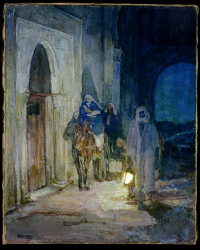
For reasons unknown to us, however, the people of that foreign land determined to take a chance on the rather ragged refugees who showed up on their door one day. And so long ago the Holy Family–Joseph, Mary, and their newborn son, Jesus–found refuge in an Egyptian village some forty or fifty miles across the Sinai from Bethlehem. And there they remained, so the scriptures tell us, for more than a year, until the news finally reached them that the maniacal monarch, Herod the Great, who had threatened to kill their son, was dead.

All of which has come to my mind in the current conversation in our country over whether or not thousands of Syrian refugees, fleeing the violence in their homeland, should find at least temporary shelter in the United States.

Oh, I am clearly not privy to all of the information, though I understand the security concerns and I know that they are far from imagined and must be addressed. Likewise, if arrangements can be made to do so, it is probably indeed better to offer them a secure and safe refuge within a corner of their own country.

What’s more, given the tragic events in Paris, I know that it is naive to assume that terrorists will not try to infiltrate those fleeing Syria, simply in order to get in to America and perpetrate their violence here. It is equally naive, however, to believe that slipping in among women and children is their only means of entrée to this country, for it clearly is not.

What we are faced with thus is the moral question as to whether or not America will live up to the words engraved on Lady Liberty in New York harbor:

“Give me your tired, your poor, your huddled masses yearning to breath free, the wretched refuse of your teeming shore.  Send these, the homeless, tempest-tossed to me, I lift my lamp beside the golden door!”

At the risk of sounding too political for a pastor, thus, I believe that both Christian conscience and American values call us to find a safe and sensible way to care for even the Syrian strangers in our midst and offer refuge to all those sojourners who are in such desperate need.

For indeed, how grateful I am that long ago an Egyptian village decided to extend a welcoming hand to the family of Jesus, showing hospitality “unawares” not just to angels, as the writer of Hebrews once put it, but to the very Lord Himself.

Flight into Egypt Henry Oshawa Tanner, 1923

Flight into Egypt
Henry Ossawa Tanner, 1923


Posted in Uncategorized | Tagged , | 5 Comments

The Bethlehem Star(bucks)

As Tony Campolo once styled it, sometimes it is a matter of “Following Jesus Without Embarrassing God.” For the current brew-ha-ha, so to speak, over the “Christmas Cups” at Starbucks is a good example of when Christians overreact to perceived cultural slights.

In case you’ve missed it, the controversy stems from the fact that the ubiquitous (not a word you can use everywhere, by the way) coffee chain has unveiled its holiday cups that are simply red with their corporate logo on the side. No snowflakes, Frosties, Rudolphs, or other spiritually significant symbols of the season, mind you, just plain red.

And, in turn, some Christians have seen red as well, with a few even suggesting that in failing to acknowledge the meaning of this season that what Starbucks is actually saying is that it hates Jesus. One evangelical pastor and self-described “social media personality”–which almost sounds like an oxymoron in and of itself–has posted a video which has already received over 13 million views, in fact, suggesting that others follow his lead in telling the baristas while ordering that your name is “Merry Christmas,” thus forcing Starbucks to write it on the cup in spite of their pagan policies.

What’s more, one of the presidential candidates has now chimed in, promising that when he is in the Oval Office that people will freely say “Merry Christmas” once again across the fruited plain, no matter what the political correctness crowd may argue.

All of that rather misses the point, however. Indeed, if those of us who actually believe in Jesus are depending upon a coffee shop or even a candidate to help promote our faith to others then we’ve got it wrong ourselves. For when it has been at its best, Christianity has often been a counter-cultural force of God’s love, calling men and women to a Kingdom with a different set of values altogether.

Don’t get me wrong. I don’t like it when either the government or the culture uses its power to put down people of faith, or to ridicule the tenets or ideas in which we believe. But in the end, it’s not up to others to interpret God’s love–it’s up to us. And we can do so best not by arguing against our adversaries–real or imagined–but by living in such a way that those around us cannot help but notice the difference and wonder why.

In the end, it should be pointed out that Starbucks indeed will continue to sell both a “Christmas Coffee” and even Advent Calendars within their stores, as well as a rather delicious Peppermint Mocha drink that is essentially a candy cane in a cup. If you want to really understand the meaning of this season, however, I would suggest that you concentrate less on Starbucks and more on the Star of Bethlehem.

Unless, of course, you’re a Christian just daring someone else to offend you.

Posted in Uncategorized | Tagged | 18 Comments

What Methodist Bishops Can Learn from the Pope

In the world of the church, it doesn’t get much higher than this. But then it’s not just the office but it’s clearly the man himself who commands both the respect and attention of millions around the globe, including much of the media, making him a virtual rock star of religion.

Watching him interact with both the powerful and the powerless in Washington on Wednesday, and listening to him talk, however, I could not help but have a little papal envy that the leaders of our own church so seldom seem to speak with such clarity and conviction.

It’s not just that Pope Francis is a prophetic figure willing to embrace unpopular positions if he feels led to do so. For to be truthful, we have a few of those among our episcopal leaders as well. But it is that when Francis speaks, he does so out of the core doctrines and beliefs of his church, articulating them so cogently that both his critics and his cheerleaders cannot help but get what he is saying. Similarly, if he carries an agenda at all, it is clearly not a political or even personal one, but a message that is deeply embedded in his church’s understanding of the faith.

The pontiff can thus speak passionately about the sanctity of life, but also about the stewardship of the earth. He can lift up the cause of both the sojourner and the soldier in our societies, and do so without any fear that he will come across as leaning either too far to the left or right. For again, if anyone cares to actually check it out, they will discover that what he says is nothing more–or less– than what Catholic doctrine believes that the gospel teaches.

And that is sadly enough what our own bishops so seldom seem to do. For enmeshed in the administration of the connection, they often forget that one of the principle jobs of any episcopos is to not just to manage the church but to “contend for the faith that was once for all entrusted to God’s holy people,” Jude 1.3, particularly when it may be under attack by the culture.

In the case of United Methodism, thus, what I would love to see is a bishop stand up and publicly defend our official teaching that “the beginning and end of life are the God-given boundaries of human existence,” and that while “we equally respect the sacredness of life and the well-being of the mother of an unborn child,” that “our belief in the sanctity of unborn human life makes us reluctant to approve abortion,” particularly those carried out simply as a means of after the fact birth control, or as a political affirmation of women’s rights.

I’d likewise love to hear a bishop remind us that “all economic systems are under the judgment of God, no less than other facets of the created order” and that “every person has the right to a job at a living wage.” Then they might argue that since the separation of church and state “should not be misconstrued as the abolition of all religious expression from public life” that the church should not simply roll over and play dead when it comes to standing up for what it believes, no matter how the political winds are blowing.

And, of course, what would really amaze me is for a bishop–any bishop–to do something I have yet to hear in four decades of being a Methodist pastor, which is not simply to announce that they will enforce the current disciplinary positions on sexuality issues, for example–or conversely, that they intend to ignore them–but to actually and accurately defend those positions and tell the members of their church why they believe that ours is indeed a biblical ethic grounded in the gospel, even if parts of our current statement could stand to lose some of the more abrasive language.

In short, putting partisan politics aside, I’d love for our bishops to exercise the same kind of moral authority grounded in the church’s official teachings that I have seen this week in Pope Francis who was, by the way, elected to his office at the seasoned age of seventy-six, or some four years older than the mandatory retirement limit for our bishops and clergy.

Or is that simply asking too much of the men and women whom we believe have been summoned by the Spirit to serve as our spiritual leaders?

Posted in Uncategorized | Tagged , | 21 Comments

The Problem with Precedents

Recently one of the leaders of our annual conference shared with me her reluctance to take an action regarding a friend because of her fear of the “future precedent” it would set for the group she chairs. And while I consider her to be a sister in Christ, as well as a genuinely sincere individual, I can’t help but think that she is sincerely wrong in this instance. For irrespective of the particulars of this case, underlying the argument she made is a fundamental misunderstanding of what precedence is all about.

To be sure, in certain civil settings the word can refer to an entire system of jurisprudence that is based upon earlier judicial decisions rather than statutory laws. But that definition of the term is a rather narrow one, not really applicable at all to most of us whose decisions are clearly not legally binding actions for all the ages to come, even in our own lives.

The dictionary therefore will tell you that a precedent is more often simply an earlier event or action that can be regarded as an example or guide to be considered in subsequent similar or analogous circumstances. It is part of what lies behind what some have called the Seven Last Words of the Church, namely, “We’ve never done it that way before,” an odd idea indeed for any who believe in new life.

Expressed more positively, it is also why we eternally optimistic Methodists so very often have a “first annual” event in our churches, believing that when we have done something once it is now a cherished tradition of the faith long before we know if it worked at all. For clearly we believe in honoring the status quo, even when it may not be all that honorable to begin with!

Within the life of faith, however, precedence is never so much about the future as it should be about the past. That is to say, we don’t so much set precedents as we may simply use them. When we don’t know exactly what to do in any particular circumstance, for instance, it can indeed be helpful to look back and see how the people of God, particularly those whose stories are told in the scriptures, handled similar challenges in the past.

When it comes to making decisions in the present, however, it is simply silly to suggest that our own wisdom is so infallible that no one in future years should ever even question it. For the truth is that God’s people in every age have the responsibility to prayerfully think out whatever question is before them and then collectively arrive at an understanding as to how to move forward, guided by scripture, the witness of the church throughout the ages, and common sense.

Equally significant, when the fear of setting future precedents takes precedence itself over actually dealing with individuals on their own basis then we’ve let the spirit of the law overwhelm the greater law of love that we are called to follow.

The truth is that as Psalm 139 expresses it, we are all “fearfully and wonderfully made” by God, even though some of us are clearly more fearful than wonderful. In dealing with others, thus, we should be careful not to let our anxiety over setting precedents override our responsibility to truly look at each person individually, judging their case independently of others.

For indeed, just imagine the positive precedent we might set if we actually did that.

Posted in Uncategorized | 1 Comment