COVID Contemplations (May 26) – “A Pew With a View, Please”

You might say that it was standing-room-only in those days.  For at least insofar as historians can tell, though believers could stand, kneel, or even lay prostrate on the floor during the first fourteen centuries of the church’s life, the one position they apparently could not adopt in worship was to sit down during the services, for there were no chairs or pews.

Indeed, in the words of Luke Harrington, “seating in churches didn’t really become a thing until parishioners got bored enough to wish they were sitting down,” that is, about the time when the focus of worship shifted from more participatory acts like confession, creeds, and communion to simply listening to long sermons, causing some to say, “Can we at least sit down for that?”

The placement of pews in churches also took on a rather commercial feel in their early years, as families often bought custom-built pews to help pay for the cathedrals. With their shoulder-height walls, doors, windows, curtains and sometimes even fireplaces, those early “skybox-seats” (a social distancing dream) were a sign of one’s status– real properties with a deed, in fact, that could be passed down from one generation to another.

Eventually, of course, such visible symbols of the inequities between rich and poor folks in church gave way to the idea of “free and open” benches, and there is still a stipulation in our own denomination’s governing Book of Discipline, in fact, that “pews in The United Methodist Church shall always be free” (Paragraph 2533.1), just in case some desperate pastor or finance committee is looking for a new source of income.

All of which makes the current conversations going on across congregations about how to re-open their sanctuaries for in-person worship at some point historically more interesting, I think.  For as entrenched as some folks are about sitting in the exact same place every Sunday, just imagine how difficult it would be if we had to worry about actual deeds and ownership and even giving refunds in closing every other pew for social distancing.

It all reminds me of what Jesus once said when he went to eat at the home of a prominent Pharisee one day.  Noticing how the guests tried to position themselves near the head of the table, the Master told his disciples that should they be invited to a wedding feast, for instance, they ought to take the lowest place to sit rather than jockey for the places of honor, “for all who exalt themselves will be humbled, and those who humble themselves will be exalted” (Luke 14.11.)  A good case for sitting in the back rows, some might say.

Whenever churches are able to re-open thus, I hope that folks will be understanding about whatever kind of physical adjustments we are going to have to make to ensure we are indeed caring for those around us.  We all may need to be a bit like the fellow who was both his church’s organist and custodian, in fact:

It’s said he had to mind his pews and keys.

Posted in Uncategorized | 3 Comments

COVID Contemplations (May 25) – “Methodist Musings on Memorial Day”

I have to confess that I really have no idea what to do today.  Because for the last 48 years or so, I’ve spent every Memorial Day dressed in church clothes sitting in a large sanctuary or auditorium somewhere for the Annual Conference session.

For those unfamiliar with Methodism, that’s our yearly meeting of pastors and lay delegates from a geographical area, in my case, the eastern third of Texas.  And our session has begun on Memorial Day weekend all these years for a simple reason:  Methodists are cheap.  We’ve taken the second of John Wesley’s admonitions about money—”earn all you can, save all you can, and give all you can”—to heart.  And since no one else has ever wanted to come to downtown Houston to celebrate a holiday weekend, the hotel rates are better.

It’s not to say that what we do at an annual conference is not important.  Forty-five years ago this week, for instance, I was first ordained as a deacon in The United Methodist Church and three years later on the same day I became an elder.  And along with all of the business matters and endless speeches I’ve sat through (think one unending church board meeting) there have been inspiring worship services and uplifting moments as well.

Mostly, however, conference is about renewing the ties that bind us as Methodists and even more particularly for some of us, as fellow pastors and preachers.  Since the days of John Wesley, in fact, every annual conference around the world has begun with the singing of one of his brother’s best hymns, written in 1749: “And are we yet alive, and see each other’s face, glory and thanks to Jesus give for His almighty grace.”

It’s a powerful moment for me personally.  For when I think of those largely unlettered circuit riders, many of whom died before the age of 35, I can’t help but glance around the room when we sing it to see the faces of those who have made it another twelve months, missing the faces of those who haven’t.  And I’ve recognized all too plainly the truth of Wesley’s third verse: “what troubles have we seen, what mighty conflicts past, fightings without and fears within, since we assembled last!”

There’s a special poignancy this year, thus, for those “fightings and fears” have certainly been manifest in the present pandemic which caused the postponement of our session for the first time in our history.  In the meantime, though, ministry goes on and I am reminded of another of Charles Wesley’s observations: “God buries His workmen but carries on His work.”

I’ll be remembering many of those workers in my prayers today, along with the relatives and friends I’ve known over the years who gave their lives up in the service of their nation.  For maybe in the end, Memorial Day has actually been a perfect time for we Methodists to meet after all.

I think I’ll grill some burgers out on the patio today too.  For isn’t that what regular people do on Memorial Day?

Posted in Uncategorized | 4 Comments

COVID Contemplations (May 22) – “Forgetting to Grow Old”

They live in three different countries but they all seem to have one thing in common:  apparently, no one ever told them about retirement.  And so they’ve simply continued to serve others, irrespective of their age.

France’s oldest physician, for instance, Dr. Christian Chenay, is not only still conducting tele-medicine calls with patients, but he continues to make weekly trips to a retirement home.  His wife is terrified that he will bring the coronavirus home and “she is right,” he admits.  And at the age of 98, he admits that he probably should reduce his activity level for a lot of reasons.

But in thinking about those folks in the retirement home, says the good doctor, “I can’t just abandon them in the midst of an epidemic.  They wouldn’t be able to manage on their own.”  So Dr. Chenay goes anyway, though he will concede that he is moving more slowly than before.

Across the channel in England, Captain Tom Moore will be knighted by the queen for his fundraising efforts after being nominated by the prime minister for that honor.  Captain Tom originally set out to raise one thousand pounds for the National Health Service by walking 100 laps of the 82 foot loop in his garden before reaching his 100th birthday.

Like an English Energizer bunny, however, Captain Tom—promoted to colonel and soon to be Sir Thomas– just kept on going and to date, he has raised more than forty million dollars (or 32 million pounds) contributed by over a million and a half supporters.  He’s not only inspired the whole country, says the prime minister, but he’s provided “a beacon of light through the fog of the coronavirus.”

And in the United States, the country’s leading expert in biomedicine, Dr. Francis Collins, was surprised in the midst of all of his non-stop work on the pandemic to learn that he is this year’s recipient of the Templeton Prize, an annual award which totals $1.3 million.  The longest serving director of the National Institutes of Health, Dr. Collins is known not only for his groundbreaking research in genetics, but also for his intellectual arguments that reconcile God and science.

“I think of God as the greatest scientist,” he has said, noting that the “elegance and wisdom of God’s creation” is “truly exhilarating.”  When a scientist discovers something no human knew before, but God did, that is both “an occasion for scientific excitement and, for a believer, also an occasion for worship.”

Of course at the age of 70, Dr. Collins is still but a youngster compared to his colleagues overseas.  But he nonetheless has demonstrated that there is no age limit on serving God and serving others.  After all, Abraham was 75 before he even received his call from God and Moses was 80 before he set out on his work for the Lord. Caleb was 85 when he asked for the mountain, and the youngest of the twelve apostles of Jesus, John outlived them all.

Maybe that’s why the psalmist asked long ago that “even when I am old and gray, do not forsake me, O God, till I declare your power to the next generation.” (Psalm 71.18) Later on the same book proclaims that “they will still bear fruit in old age; they will stay fresh and green.”  (Psalm 92.14)

And if you could ever get them to stop long enough to do so, I have a feeling that Dr. Chenay, Sir Thomas, and Dr. Collins, would probably all say “Amen.”

Posted in Uncategorized | 3 Comments

COVID Contemplations (May 21) – “What Aretha Said”

I have to confess that I grumbled as we rumbled along behind him.  For as if the roads weren’t bad enough on the island—to say nothing of the crazy drivers sometimes barreling right towards you at dizzying speeds—when we got behind a large dump truck going up a steep hill it was difficult indeed to even stay in the right gear.  And then I saw the hand-painted sign on the back of that old truck that turned my impatience into praise.  For it said simply,

“GOD IS GOD.  RESPECT DUE.”

And when all is said and done, that’s a good reminder, whether on a mission trip or just on an outing to the grocery store.  For amidst all of the inconveniences of the present time, the truth is that whatever our circumstances, God hasn’t changed at all.  His nature, His character, and most of all, His amazing love for you and me is exactly the same.  And because it is, He is worthy of all the respect that we can give Him, no matter what else may be happening in our lives.

St. Paul put it this way long ago when he wrote to his friends in Philippi:

“I know what it is to be in need, and I know what it is to have plenty.  I have learned the secret of being content in any and every situation, whether well fed or hungry, whether living in plenty or in want.”

And that secret is simply to remember that we’re not only not in charge, but we never were.  For there is only One who created the heavens and earth and to whom this earth still answers. What’s more, whether we know it or not, He is the same One to whom each of us must one day answer as well.

In the meantime, God deserves more than our half-hearted worship or passing praise:  He deserves our respect.  The dictionary, of course, defines that as a “feeling of deep admiration for someone or something elicited by their abilities, qualities, or achievements.”  But it was Aretha Franklin who said it half a century ago in a way that still resonates today.  Walk into any room, in fact, and sing “R-E-S-P-E-C-T” and I bet you that someone will respond with “Find out what it means to me!”

Perhaps as the virus wears on—and the summer heat comes on—we can lower the temperatures all around us, no matter where we may be rumbling along.  For when we remember just who God really is, I have a feeling we’ll find out as well to whom all of our respect–and love– is actually due.


Posted in Uncategorized | 1 Comment

COVID Contemplations (May 20) – “MYOB”

We can see it at the very beginning of God’s Word when He made it clear to Cain that we have indeed been called to be our brothers’ and sisters’ keepers.  Likewise, just before the back of the book, 1 John 3.17 rather pointedly asks that “if anyone has material possessions and sees a brother or sister in need but has not pity on them, how can the love of God be in that person?”

But in between those passages, in Romans 14.4, St. Paul had a question of his own as well, namely, “Who are you to judge someone else’s servant?  To their own master, servants stand or fall.” And even Jesus told Peter when he asked about the future of another disciple, “What is that to you?” (John 11.22)

Or to put it another way, “Why don’t you mind your own business?”  And that would seem to be the operative word as our society, including our churches, begin to re-open in the coming weeks.  For the temptation to judge the actions—or inactions—of others, and even the intention of their hearts in some cases, will be an enormous one, I fear.

Some folks are more than ready, for instance, to press the play button and resume their lives.  For the enforced quarantine may have done a number not just on their nervous systems, but on their resources and retirement plans as well.  They may not have caught a Covid-19 fever but they’ve struggled mightily with cabin fever and some may have even seen their marriages or mental health begin to collapse under the strain.

Others, however, may have sound reasons to stay in and stay more cautious.  For even if an individual is not over seventy or with medical conditions that compromise their immunities, the truth is that there are all kinds of background stories that you and I know absolutely nothing about:  family histories, caregiver responsibilities, hidden health concerns, anxieties or deep-seated phobias… you name it, someone you know probably has it.

And as these two scenarios unfold and even collide in the days ahead, it will be up to all of us to follow the admonition of Jesus to “judge not that we be not judged” (Matthew 7.1) Some will wear masks around us, for instance, and others will not.  Without becoming a Face Covering Cop, simply move away from them if you’re not comfortable.  Some will seem stand-offish or overly cautious; remember there’s a history you haven’t heard and give them their space.  For as Rosaria Butterfield once suggested, “we never know the treacherous path that others take to arrive in the pew that we share Lord’s Day after Lord’s Day.”

What we do know, however, is that regardless of how others may act, in the end it’s not up to us to correct or admonish them, for they are not our servants at all.  Instead, they belong to the Lord who can do whatever He needs to with them.  So put on your patience, resist the urge to criticize, give others far more slack than you may think they deserve, and don’t even roll your eyes at them.  Don’t take names and don’t take offense.

God can handle each of us individually in the school of life.   And at least insofar as I know, He has not appointed any of us to serve as His hall or cafeteria monitors.

Posted in Uncategorized | 5 Comments

COVID Contemplations (May 19) – “Fairmeadow News”

It’s better than the BBC.  For if you’re interested in a first-hand report as to what is happening these days in the United Kingdom, and more specifically, on Fairmeadows Way in the Midlands, the news from our five-year old granddaughter Talitha can’t be beat.

Assisted by her older brother Jed, and her younger sister, Madi, Tali has taken to composing an almost daily report, dictating it to her mom who in turn is churning it out on an old fashioned typewriter.  And among the hard-hitting reports last week was an entry labeling Corona Virus as a “Fun Stopper” for kids and another article asking if masks are on the way to England.  After all, the story explains, “in Texas and other states in America, masks are now the new normal.”  (The reader was informed that if so, “the Harvey family has plans to make their own animal face masks.”)

The missive also includes a Gardening Report, commenting that “after a surprise late spring frost, gardeners are busy planting new seeds and checking on old ones” but that “lots of sprouts are coming up” all the same.  There’s a Weather Report too, letting readers know, for example, that “today was partly sunny but it was perfect weather for a family bike ride.”

Most significantly, the latest issue has a headline reading “Church Is Closed…and Open,” explaining that the church building remains closed again this weekend (and will be through the summer in England, at least according to the Prime Minister) but “the church is still alive in the people.”

And at the risk of pointing out the wonder of genetics, I couldn’t have said it better.  For as we stumble forward midway in yet another month of the global pandemic, the church around the world remains alive indeed “in the people.”  In the numerous ways in which congregations like our own have continued to reach out to those in need, and even in the dedication which so many have shown in logging onto livestreams, we’ve demonstrated beyond debate that you can close our doors but you can’t close our hearts.

We’re working, of course, on a re-entry plan and hope to be able to have those who are comfortable doing so return to live worship in our super-sanitized sanctuary in June, even while we keep the livestream lively for our saints who may be more vulnerable to catching the coronavirus from others.  And when we resume live worship there will be a different feel to it as we’ll adapt it to the public health guidelines intended to keep everyone healthy.

But in the meantime, I’m happy to share in Tali’s assessment that the church is still alive in the deepest understanding of what being the “gathered people” (even if still a little separated) is all about.  In fact, it appears that lots of sprouts are coming up when it comes to faith as well.  For as Psalm 8 reminds us, even out of the mouths of children, God has ordained His strength.

I’ll let you know if there’s any more breaking news from across the pond.  But in the meantime,  just in case you were wondering, it was “mostly sunny” last week with a high of twelve degrees Celsius… whatever that means.


Fair Meadow News

Posted in Uncategorized | 7 Comments

COVID Contemplations (May 18) – “The Quarantine Fifteen”

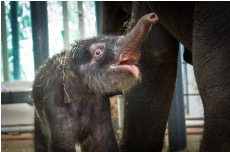
He wasn’t exactly a small bundle of joy.  For after a fairly short labor for his mother, Nelson entered this world last week at the whopping birth weight of 326 pounds.  And you have to respect any twenty-nine-year-old mother that can do that, even if she is an elephant named Shanti in the Houston Zoo.

It was still a little scary, to be sure, for almost immediately after his birth, Nelson had to undergo emergency surgery by the excellent veterinarians at the zoo to repair a torn vessel.  And just in case he needed a transfusion, the rest of the elephant team simultaneously began collecting whole blood from others in the herd, a task that required not just skill and training but a whole lot of hutzpah as well, I suspect.

Fortunately, in the end, the surgery was successful, and Nelson and his mom Shanti were reunited.  Before the day ended, in fact, the “little” tyke was up and walking on his own. (It helps to have four legs when you start out.) But the dedicated zoo team is still watching closely just to make sure in their words that the bonding goes well and—get this—that Nelson “hits his weight goals.”

And for many folks who have been trying their best to avoid that “Quarantine Fifteen” weight gain during this period of staying in that has to sound a little funny.  For when you start out at 326 pounds—a bit more, by the way, than the two to three hundred pounds that most baby elephants weigh when they are born — just exactly what additional weight goal do you really need to shoot for?

To be certain, adult elephants can weigh anywhere from five thousand to fourteen thousand pounds, so Nelson actually has a long “weigh” to go.  Not so much for you and me, however.  For as these weird weeks wear on it’s demonstrably clear that increasing our exercise and outdoor time is one of the best responses we might make to this strange spring.  Indeed, if our bodies really are “the temple of the Lord,” a favorite metaphor that St. Paul uses with both the Corinthians and the Ephesians, we can probably all use this time to spruce up the place a little.

Hitting our “weight goals” may take us thus in the opposite direction of Baby Nelson, though for some folks staying healthy has always been a lifetime goal.  But at least for me, well, let’s just say I’m hoping to follow the motto of John the Baptist when it came to Jesus, namely, “He must increase, and I must decrease!” (John 3.30)

Photo from Houston Zoo

Posted in Uncategorized | 4 Comments

COVID Contemplations (May 15) – “Take a Bough”

It’s a little like that old familiar nursery rhyme.  For whether or not the idea was indeed based upon the practice of some Native Americans to suspend their birch-bark cradles in trees, or it was instead a reference to the “tree top” or crow’s nest on British navy ships, it eventually found its way into Mother Goose’s Melody published in London in 1765.

And, based upon personal observation, I can confirm that “when the wind blows” the bough (cradle or not) will indeed break sometimes.  Or at least that’s what happened to the large hackberry or celtis tree in our front yard.  For following some brisk winds, one of its branches snapped this week, bringing a good part of its “deciduousness” down to the lawn.

To be sure, it’s perhaps not all that surprising for the tree is, after all, a part of the hemp or cannabaceae family which we might expect to be rather “laid back.”  And admittedly, that tree has needed trimming for a good while.  But I kept putting it off simply to avoid the cost and the hassle.  In the end, though, the truth is that we can either trim the excesses of our lives or wait until someone else trims them for us, whether we’re ready for it or not.

Just before describing the messianic shoot of Jesse that was to come, in fact, the prophet Isaiah rather starkly suggested that God will “top off the boughs with great power,” felling the lofty trees and bringing low the tall ones (Isaiah 10.33.)  And eight centuries later, St. Paul told the Romans that some of branches of God’s family tree were broken off not just to allow Gentiles like us to be grafted in, but because of their own unbelief. (Romans 11.17-24).

Most of all, smack dab in the middle of His final sermon to the disciples, Jesus proclaimed that our heavenly Father “cuts off every branch that bears no fruit, while every branch that does bear fruit He prunes so that it will be even more fruitful” (John 15.2). And just as a healthy hackberry is supposed to produce fruit (berries which the birds love, by the way), so too are you and I.

Perhaps this unplanned season we are in thus is a time of pruning, designed to cut away dead or overgrown branches to encourage the growth of better ones.  For people don’t simply wander into holiness nor does it happen on its own.  But times like these may give us the chance to trust God and intentionally try to become more like Christ, even if it does feel a little like we’re being chopped up!

Next time we get a good wind blowing, thus, take a look at both your trees and your life.  And if there’s something that’s needs pruning or even cutting out, take the steps to do so now rather than put it off any longer.

Don’t say Mother Goose didn’t warn you.

Posted in Uncategorized | 3 Comments

COVID Contemplations (May 14) – “Healing Houston”

It started with the soldiers at Camp Logan, an army training base then on the far western edge of Houston now known as Memorial Park.  For with thousands of young men confined in a relatively small area, the virus quickly spread across the camp with some 3,091 cases in just two months, even as it was beginning to claim as many as 100 million lives worldwide.

And for one physician, Oscar Norsworthy, it was all simply overwhelming.  For the small private hospital near downtown that he had founded ten years earlier had only thirty beds.  When the Spanish Flu struck the city in 1918, patients subsequently doubled up not only in those beds, but in makeshift spaces in the hallway and even on the roof.  It was not surprising then that after the crisis began to abate, completely worn out and spent, Dr. Norsworthy decided it was time to leave Houston and go pursue additional training in the therapeutic effects of a newly discovered element, radium.

The good doctor, however, first had to find a buyer for his hospital, someone he could trust to maintain the high ethical standards he had lived by.  And the obvious candidate was to turn to people of his own faith, the Methodist Episcopal Church, South.  In the last month of 1919, thus, Oscar Norsworthy and his wife made a generous offer indeed to local Methodists.  Though his property, building, and medical equipment were valued at $87,000, in fact, he sold it to the church for only $35,000 on the condition that they expand the hospital with a new building to be ready for the next great pandemic.

The initial members of the board for the hospital read like a Houston Who’s Who, including Walter Fondren (a founder of Humble Oil, now Exxon Mobil), James A. Elkins (a leading attorney with his partner William Vinson), Jim West (a rancher and oilman), and Jesse Jones (newspaper publisher, banker, and a later U.S. cabinet member), among the list.  But the support for the hospital came as well from Methodists of far more modest means all across East Texas.

Today, of course, Houston Methodist Hospital is a leading voice in offering incredible medical care to patients, with eight area hospitals now in the system welcoming more than 115,000 patients from around the world each year.  There are almost seven thousand physicians on staff, with over $141 million in annual research expenditures and more than 1.3 million patient encounters.

Significantly enough, however, nursed in a pandemic more than a century ago, it has stepped up to continue to serve the present age in this new time of global outbreak, as well.  For in the end, the calling to heal the sick remains part and parcel of who we are as followers of the Great Physician.

God still “heals the brokenhearted and binds up their wounds,” as Psalm 147 reminds us.  And as a lifelong Methodist, I’m grateful indeed  for all that has come out of Oscar Norsworthy’s efforts so long ago.

He really did create a hospital with a soul.

Posted in Uncategorized | 3 Comments

COVID Contemplations (May 13) – “Dealing With Delays”

It happened a lifetime ago, back when an Iron Curtain still divided Europe and those in the eastern part of that continent faced numerous restrictions when it came to practicing their faith.  For it was in that context that I found myself in a train station one day waiting to meet a man I didn’t know in a place I had never been.

Only at the appointed time, he never came.  And an hour later he still wasn’t there. So as I nervously waited, sitting on the floor and trying my best to blend in with others, I pulled out my Bible and turned back to where I had been reading the day before, Hebrews 9.

And then, with one eye on the Bible and the other on my watch, the words of Hebrews 10.36 practically jumped off the page:

“You need to persevere so that when you have done the will of God, you will receive what He has promised.  For in just a little while, he who is coming will come and will not delay.”

Saying a quick prayer, thus, I closed the Bible and stood up, only to bump into a man who turned out to be the one I was supposed to meet there.  And as we walked out of that station together, I couldn’t help but be amazed at how sometimes the scriptures not only speak, but they do so rather specifically.

Oh, I know all about not taking verses out of context and how the particular reference in that passage speaks to the return of Christ one day.  But that afternoon in a vast train station in a strange and even scary city where I knew no one, God used them nonetheless to talk to my heart and remind me that no matter how or when the events of our lives may play out, God is yet in control of them.

After ten weeks of shutdown, I’m beginning to feel a bit like I’m back in that train station waiting for the unknown. For just like many others, I suspect, I’m done with the virus and want to get back to normal.  But until that moment comes, it seems my task is to persevere in doing the will of God—to love and care for others and to do no harm because of my own impatience.  Or, in short, to willingly wait and trust that an end to this season really is ahead for “He who is coming will come and will not delay.”

So make it so, Lord, make it so.

Posted in Uncategorized | 3 Comments