COVID Contemplations (April 14) – “Donne and Undone”

I have no earthly idea how any of it works in the first place, but I’m open to the idea that it’s actually magic.  For all I know is that two minutes before our Easter morning “ALIVE-Stream” was about to go online on Sunday our church servers crashed and folks began getting those dreaded “Internal Error” messages.   And with absolutely no evidence for saying so, I’m going with the theory that the hundreds of thousands of people trying to log-in all at once caused it.

Fortunately, our church is blessed with an amazing communications and AV team and between them and our computer guru (thanks Oliver, BJ, Brian, and Roland), we were back up and ready to go within a few minutes.  And even better, most folks patiently waited while our techno-wizards figured out a work-around to get our website back online.

All of which reminds me of why I went into humanities and not the sciences or technology in college many years ago.  For just as St. Paul once observed, “there are different kinds of working but in all of them and in everyone it is the same God at work.” (1 Corinthians 12.6) And how great it is that we don’t have to try to do it all ourselves, or even envy those who have talents that we do not.  In that respect, it is somewhat ironic that in this age of forced separation we are thus rediscovering just how much we need others and how connected we really are.

In a similar way, it was while recovering from a different serious illness almost four hundred years ago that an English poet and rather reluctant preacher penned some “Devotions upon Emergent Occasion.”  And in a single verse of seven lines, John Donne made a curious comparison indeed, suggesting that each person is like a part of a continent.

“No man is an island, entire of itself,” he wrote, but “every man is a piece of the continent, a part of the main… if a clod be washed away by the sea, Europe is the less as well as if a promontory were.”

A lot like one of those peninsulas jutting out into the sea, I have a feeling that many folks have been exposed to the winds and the waves beating against them in this strange season.  But as we learn to lean upon each other—six feet apart, of course—I am hopeful that we may discover anew that our interdependence upon those around us, our “involvement in mankind” as Donne suggested, is actually a gift of God as well.

Or as another poet of sorts, the late musician Bill Withers, so famously expressed it in his signature song, “It won’t be long ‘til I’m gonna need somebody to lean on.”

I’m just hoping my non-humanities friends will still be here to work their magic one more time.
Posted in Uncategorized | 5 Comments

COVID Contemplations (April 13) – “Step Away from the Screen (After You Read This, That Is)”

(On this “day off” after Easter, I’m delighted to offer a guest devotional written by one of my favorite young theologians, Angela Harvey.  She happens to be our daughter but she also holds degrees from all kinds of great places.  She and her husband Steve live in England where he is a priest in the Anglican Church and they are happily raising three of the cutest children in all of that merry old kingdom, our grandkids. The other three live in Katy, by the way.)


“If we’re adding to the noise, turn off this song…” — Switchfoot, 2003

I hesitate to write this, as it’s one more noise you’ll encounter today. One more screen page, one more block of words, one more thought amidst the endless things our minds are caught up with now. The pandemic is truly an info-demic and most of us probably don’t need one more thing to read today.

Yet if you’re like me, you keep on reading the news and blogs like this, and day by day, looking for meaning online in this strange time. As much as we know that too much media and screen time isn’t good for our mental health or our souls, it’s hard to keep our fingers from switching on a screen to give us a glimpse of the world, to make us feel informed and connected somehow. And especially now we are needing those screens even more to connect us with our families and friends and churches and schools and workplaces.

It is all a bit much and hard to figure out, isn’t it? It’s not easy to see how to live well these days. When I recognize that I need something more spiritual than NPR or BBC, I find myself turning to read Christian leaders I trust, and then get caught up in yet another cycle of online things (albeit good things) to take in and process. Solomon was right that the making of many blogs is without end, and much scrolling wearies the soul (Ecclesiastes 12.21)!

We need each other and we’re finding each other online these days. But if you’re feeling a bit weary of all the screens, maybe it’s time to remember the One we have seen face-to-face, and with Whom we can always meet, without the need for any veil, or screen, or even social distancing, between us.

Paul tells us in 2 Corinthians 3 that when we, with unveiled faces, behold the glory of the Lord, we are transformed into His image. What a promise! In beholding Jesus we are made like Him. And only in seeing Jesus more can we start to see everything else around us right; only as we look more like Jesus can we find our true way in this world. What more might our aching world need now but more of Jesus, more of Jesus in us? Perhaps the best thing we can do to respond to the current crisis is to turn off our devices for a while and turn our eyes upon Jesus.

Let’s go in peace to love and serve the Lord… away from a screen and before the face of Jesus Himself.

Posted in Uncategorized | 7 Comments

Holy Week COVID Contemplations (April 11) – “Raising Hell with Jesus”

His critics thought it was all over. The show had closed, the curtain (though torn in two somehow) had fallen, and the reviews were in: Jesus was a fraud, but fortunately He had been taken care of the day before and was no longer going to be around to raise hell.

Oddly enough, however, that’s precisely what Jesus may have been doing on the Saturday that followed Good Friday. For though none of the gospel accounts tell us just what happened on this otherwise quiet day, passages elsewhere in the scriptures give us hints of a rather extraordinary journey which took place in between the crucifixion and the resurrection. 

Ephesians 4.9 suggests that Jesus descended into the depths of the earth to bring back the souls who were there. Similarly, the psalmist also foresaw that God would one day take the captives on high (Psalm 68.18), just as Acts 2.30 consequently assures us that David was not abandoned to the realm of the dead either, despite having lived centuries before Jesus ever came onto the scene. 

It is Peter, however, who specifically tells us that the Lord was put to death in the body but made alive in the Spirit, “through whom also he went and preached to the spirits in prison, who disobeyed long ago” (1 Peter 3.19-20). And so accordingly, we proclaim it in the Apostles’ Creed: “He was crucified, dead and buried…He descended into Hell… the third day He rose again from the dead.”

Oh, some still find that singular clause in the creed to be troublesome, I understand. And to be sure, whenever we try to nail down a particular time sequence with the Timeless One, there’s bound to be some issues. For in truth, our linear understandings of time—yesterday, today, and forever—are not binding at all upon the God who created the whole idea itself.

Still, I can’t help but sense that there is something very right about the notion of Jesus busting into Hell and setting all kinds of captives free. For it tells me that Jesus really did come for all, even those who never knew Him on this earth, and that if not even His borrowed grave could hold back the power of God, our graves may not be able to do so either.

Maybe this quiet Saturday before Easter may be a good time therefore for those of us who follow Jesus to “raise a little hell” with Him, that is, to not only “renounce the devil and all his pomp” (as the old liturgies used to put it) but to set up a rescue mission to drive out whatever hellish forces that the enemy may have brought into the lives of others.

After all, not even the gates of Hell can hold back the Son of God when He’s ready to set you free.

Posted in Uncategorized | 3 Comments

Holy Week COVID Contemplations (April 10) – “God’s Friday”

You have to wonder what’s so good about it anyway. For it was on this day, long before the sun had even arisen, that Jesus found Himself hauled before a kangaroo court that had already convicted Him, despite being unable to come up with any even false evidence that they could actually use against him.

Likewise, it was on this day that his accusers were so anxious to be rid of Jesus that they couldn’t wait for the Roman governor to finish his breakfast before they dragged their prisoner next over to the place where Pilate was staying, making one wild accusation after another against their fellow Jew to the Gentile representative of the occupying foreign power.

And though Pilate seemed singularly unconvinced about their charges, he was an astute enough politician to know when it’s better to go along with the crowd which had clearly been whipped into a frenzy by the Jewish authorities. And so the governor allowed some whipping of his own, ordering his soldiers to strip the prisoner of every last vestige of His humanity and dignity.

Then when even that wasn’t enough to satisfy the blood thirst of the accusers of Jesus, Pilate finally gave in and ordered that the prisoner be executed. They paraded Him through the streets of Jerusalem to get to a hillside just outside the city walls, conscripting a passer-by named Simon on the way to help carry the wooden beam that was to be His final pulpit, and then Jesus Himself was hoisted up on that splinter-filled saber where He hung for three hours as His life was literally being poured out.

The crowds came by, hurling their taunts and insults.  “He saved others,” they said, “but he can’t save himself.” “He trusts in God, so let God rescue him now if He wants him.” And all the while the life spirit of Jesus continued to be siphoned out, not only from the physical excruciation of crucifixion, but from the sheer agony of abandonment as well.

“My God, my God,” He called out, somehow remembering even in the fog of His frailty the ancient words of the psalmist, “why have you forsaken me?”

Until at last it was finished and He gave up His spirit.

But it was at that precise moment that something rather incredible happened, as well. For as the gospel account tells us, not only was the curtain in the Temple torn in two from top to bottom, but the earth shook, the rocks split, and the nearby tombs broke open, releasing many holy people who had died to come out and be raised to life once more.

No wonder a Roman guard who was standing nearby, though clearly terrified, understood what all of the religious and political authorities in Jerusalem had failed to grasp: “Surely this was the Son of God.”

And because He was, that’s what was good about this day. For on a bleak hillside long ago and far away, this day became “God’s Friday,” an unparalleled hinge point in history when the tide began to turn and in the meanest of circumstances, hope found a crevice from which to creep back into our lives.

Today is a time for remembering just what Christ did so long ago and why it matters. So let the reality of the events of this day become intensely personal for you once more. Do not allow these hours to go by without stopping to offer a prayer of fervent thanksgiving for the gift of your salvation. Go to the cross at least sometime this day and contemplate what really happened there.

For as bad as it was, it was a Good Friday for us indeed.


Posted in Uncategorized | 2 Comments

Holy Week COVID Contemplations (April 9) – “One Last Lesson”

If you knew you were going to be arrested tonight and probably executed tomorrow… how would you spend today? For that’s exactly the situation that confronted Jesus on this Passover Eve long ago when He gathered His little band of followers together to celebrate that ancient festival of deliverance.

Would you try to get away from those looking for you before they could do you harm? Go on the lam and escape? For indeed, from the Garden of Gethsemane, all Jesus had to do was to hike half an hour or so up the Mount of Olives, go over the ridge and then disappear into the Judean wilderness where they could never find Him.

Would you instead begin to prepare a defense for the trial which was coming? Maybe gather up documents to support your case, find some corroborating evidence, round up some witnesses, and hire the best attorney you could find, if nothing else, just to slow the whole process down until you could begin to figure it all out?

Or would you simply try to spend some meaningful time with your friends and family while you still could? Share in a holiday meal just as you might have done many times before? Let them know what they meant to you?

In the case of Jesus, that’s precisely what He did. For let’s be clear about it: Jesus knew exactly what was about to happen in His life. He knew what was in the heart of his betrayer and in the muddled minds of even His closest friends like Peter. He knew that very soon He would be returning to God. But He also knew that He had come from God and that the Father had put all things under His power.

And so, “having loved His own who were in the world, He now showed them the full extent of His love,” as John 13.1 reminds us. Before they had even finished eating the evening meal, in fact, Jesus got up, took off His cloak, wrapped a towel around His waist, and began to wash His disciples’ feet.

They protested, of course, for washing the feet of someone else was not only a dirty job for the lowest of servants in a household, but it seemed particularly inappropriate for a teacher like Jesus to do for His students. But the Master– who understood so profoundly the paradoxical power of serving others– went right ahead, setting before them an example that they could never forget.

Years later, in fact, His followers still talked about not only His example but the new commandment that He also gave them that night–that they love one another even as He had loved them. And that “new commandment” or mandate (or as it is translated into Latin, the novum mandatum) is what has given this day—Maundy Thursday—it’s name.

To put it another way, Jesus spent the last full day of His life crafting His final lesson for those who had known Him, which was purely and simply that we love one another.

Even if we disagree, or we’ve been disappointed by someone else.  Even if they don’t share our faith or fit into our fellowship.  Or they voted the wrong way in the last election.  For if we love one another, so Jesus said, all will know that we really are His disciples.

I wonder if today might not be an excellent time indeed to put that ancient new mandatum into practice.


Posted in Uncategorized | 1 Comment

Holy Week COVID Contemplations (April 8) – “A Quiet Day at Home”

He was not exactly under a “Stay At Home” order but He did so anyway.  For following his volatile encounters in the Temple on Monday, and His subsequent conflicts with the Pharisees and Sadducees the next day, on Wednesday of that pivotal Passover Week long ago it is thought that Jesus remained in the home of his friends, Mary, Martha, and the not-so-late Lazarus in their little village on the eastern ridge of the Mount of Olives.

Back in Jerusalem, three of the evangelists—Matthew, Mark, and Luke—all tell us that the chief priests and teachers of the Law were busy plotting how to arrest the Teacher, looking for some “sly” or deceitful way for how to kill him, only secretly so that the crowds which had come to Jerusalem for the Feast might not erupt into a riot.

But in Bethany, we can only imagine what Jesus’ thoughts must have been as He surely knew that the hour of His death was coming closer. Was He afraid for what was about to happen? Concerned for those who had followed Him? Anxious that the heavenly plan might somehow go awry? Or was He content to simply spend the day with His Father in quiet reflection and prayer? For I rather suspect that Jesus was a whole lot more comfortable with holy silence than most of us usually are.

The evening arrived, and with it, so Matthew tells us, an invitation to a dinner given in his honor at the house of Simon the Leper, an individual whom we can easily envision did not entertain all that much at all, given the pariah status in that society which his name would imply.

Nonetheless, it was there at that dinner that a woman showed up. (John says it was Mary–her sister Martha was helping to serve the meal, of course.)  And before anyone could stop her, she pulled out an alabaster jar containing very expensive perfume which she had brought with her-—no doubt her most valuable possession which she had been saving for years-—and then broke it to pour the perfume on the Master’s head and feet.

The treasurer of the little band-—Judas-—objected, of course, indignantly asserting that the perfume could have been sold for more than a year’s wages and the money given to “the poor” (though John suggests that Judas sometimes apparently considered himself among that group, helping himself to whatever was in the common purse whenever he wanted to do so.)

But Jesus said simply, “Leave her alone—she has done this to prepare me for burial.  What she has done is a beautiful thing and wherever the gospel is preached throughout the world, her story will also be told.” And so it has been, even to this very day.

It causes me to wonder a little, however: on this quiet day before all the busyness of Maundy Thursday and Good Friday begins, are we ready to not only seek to know God’s will in quiet, as Jesus did on this day, but also to bring to the Master whatever we’ve been holding back and hoarding for ourselves?

Indeed, today before another Easter arrives, might it not be a good time for you and me to retreat back to our own Bethany and see just what God may have to say to us as well?


Posted in Uncategorized | Leave a comment

Holy Week COVID Contemplations (April 7) – “A Questionable Q&A”

Those now daily press conferences with the coronavirus task force made me think of it.  For having once been a journalist myself (in a lifetime long, long ago), I understand the importance of asking even uncomfortable questions, though I’m not sure freedom of the press has ever justified being unduly rude or playing “political gotcha” with others.

And to be fair, it’s not as easy as it looks. While in college when interviewing a presidential candidate at the time, George McGovern, for instance, the only hard-hitting question I could come up with on the spot was, “Where’s Eleanor today?”  Not exactly “speaking truth to power,” I know.

Still, the interchange which happened on Tuesday of Holy Week between Jesus and some of His harsher critics was not just direct, but downright adversarial.  For faced with the rather incredulous claims and actions of Christ, His opponents were clearly out to find something—anything—to get on Him.  To use a popular metaphor, they were throwing spaghetti all over the walls to see what might stick.

To be sure, the Sadducees who ran the Temple were already upset with Him for what had happened just the day before when Jesus had driven out the moneychangers and the merchants.  But when He came back to those same courts on the following morning, this time it was the Pharisees who started the line of questioning.

“By what authority are you doing these things?” they wanted to know (for clearly it seemed to be a stronger one than their own.)

“Is it right to pay taxes to Caesar or not?” they queried (knowing full well that almost any answer Jesus might give could incriminate Him with someone.)

“Teacher,” the Sadducees then chimed back in, “if a man dies without having any children and his widow marries his brother– and then it happens again six more times–then whose wife will she be at the Resurrection?” (An interesting question indeed, since the Sadducees didn’t even believe in the idea of resurrection.)

But Jesus quite deftly answered them all before posing a question of His own to those around Him: “What do you think about the Christ? Whose Son is He?”

And it strikes me that Jesus might ask the same question of us whenever we may try to play word games with Him as well. For in the end, it’s not about theological acumen or intellectual acrobatics– it’s about what each of us decides to believe about this Jesus.

Holy Week brings us smack dab in front of that Man from Galilee who claimed that He was sent from the Father above. And today is a time for putting aside our personal conflicts and honestly dealing with the truth He presented to us.  For Jesus, in effect, spoke power to truth, that is, He demonstrated in both His words and His deeds unquestionably the reality of who He was.

And not even the snarkiest journalist of the day could find a single way to prove Him otherwise.

Posted in Uncategorized | 4 Comments

Holy Week COVID Contemplations (April 6) – “Trouble in the Temple”

If Mark was right, then it happened the day after His rather triumphal Palm Sunday entry when Jesus returned to Jerusalem after staying the night at Bethany.  For upon entering the Temple courts—perhaps the most crowded spot in the whole complex– the gospel writers tell us that Jesus created quite a stir by overturning the tables of the moneychangers and those selling lambs and doves.  And at least to some observers that might have seemed like a bit of an overreaction.

After all, the Law of Moses spelled out that when pilgrims came for a festival like Passover that they shouldn’t show up empty-handed to the Temple but ought to be ready with something to sacrifice there.  And who wanted to travel all the way to Jerusalem with livestock or even a dove in their hands?  Particularly when everyone knew that the Temple priests primarily approved for sacrifices only the animals which they also rather conveniently sold.

Likewise, it just made sense that those Sadducees who ran the Temple required that offerings be made in one currency only, namely, Tyrian coins.  (Never mind that such coins were stamped with pagan images—they had the highest content of pure silver and oddly enough, the money changers were also usually a part of those same aristocratic families.)

All in all, thus, it was quite a successful enterprise for the Sadducees, most of whom were not legitimate priests at all but had bought their position from the Romans.  And it seemed logical to locate these “services” (with a “convenience fee,” of course) right next to the Royal Stoa or covered porch on the south side of Herod’s Temple where the main entrance was located.

Jesus, however, seemed singularly offended by the whole idea, not only knocking all the booths and tables over, but also exclaiming in a loud and impassioned voice, “How dare you turn my Father’s house into a market!” (John 2.16) Because more than just reacting to the blatant price gouging going on, Jesus was telling them that they had missed the whole point of what it means to love God.  In fact, the incident with the moneychangers was not so much about only cleansing the Temple, I think, as it was about reinterpreting the whole sacrificial system as a means of truly worshiping God and loving Him with all of our hearts without keeping Him an arm’s length away.

Instead, what Jesus rather vividly demonstrated that day is that true worship has nothing to do with either the convenience of the worshipers (ouch) or those who job it was to count up the money at the end of the day and keep the whole thing going (double ouch).  And in a season of decided inconvenience for most of us–when we still can’t physically go to church at all–that’s a comforting word.  For perhaps this Holy Week can actually be about something else, namely, rearranging our priorities to simply have a heart for God.

Oh sure, it was dramatic.  But what else could Jesus do when those who should have cared the most for the Temple instead took advantage of their position to make a profit for themselves?  He even quoted from Jeremiah 7.11 about the den of robbers, which goes on to say, by the way, that God declares, “I have been watching.” And just in case you didn’t know it, He still is.

He’s not even six feet away.

(Log on each day of this Holy Week for a special word about Jesus’ final week in Jerusalem, and why it matters.)

Posted in Uncategorized | 1 Comment

COVID Contemplations (April 3) – “Doing the Wave”

It was the wrong time of year, but in all of the excitement of the moment no one seemed to care.  For normally among the Jews in the first century, it was during the fall festival of Sukkoth or “Booths”—easily the most popular holiday of the year—when worshippers would parade through Jerusalem up to the Temple as they waved a makeshift bouquet of willow, myrtle, and palm branches known as a lulav.

Along the way, they would also recite the scripture for Sukkoth, Psalm 118, including the words of verse 25, “Lord, save us!” (howosiah or hosanna in the Hebrew) and quite literally, “Lord, rush us to success!”  And that, in turn, was followed by the next verse of the psalm, “Blessed is he who comes in the name of the Lord!”

Even if the season was wrong, however, the sentiment was exactly right.  For when Jesus descended down the Mount of Olives that spring day to begin the week of Passover the crowd around Him couldn’t help but honor Him just as at Sukkoth, or as they might have done for any king or conqueror who entered the city.  The palms themselves not only symbolized victory and grandeur—the majestic date palms which grew at Jericho often reached fifty feet or more, for instance—but they were regarded as tokens of joy and goodness as well.  Images of palms were even used extensively on Jewish coinage and came to be representative of the land of Israel itself.

And so the crowd began to pick up palm fronds and line the roadway ahead of Jesus, making it all the smoother, as well as wildly wave those branches to celebrate, just as the words of Leviticus 23.40 and Nehemiah 8.15 had instructed them.  Some may likewise have thought of the experience of the Maccabees more than a hundred years before when the Jews revolted against the Seleucids and once again entered Jerusalem with praise and palm branches, as recorded in the Apocrypha (1 Maccabees 13.51-52).

But for whatever the reason, it all got so rambunctious that the Pharisees in the crowd told Jesus to shush his supporters.  Jesus replied, though, that if His followers kept silent, even the stones themselves would cry out.  And as churches across the world gather for another Palm Sunday this weekend—largely bereft of any onsite worshippers at all—it may indeed be up to the stone walls of those buildings to pick up the mantle of praise this year.

Wherever you may be, however, I hope you will get a little rambunctious on your own.  Wave a branch of whatever you’ve got.  Go out in the backyard and yell “Hosanna” as loud as you can.  Put a picture of a palm tree or frond in your front window.  For just as He did long ago when the world was also a bit mixed-up, Jesus will be riding into our lives once again on Sunday.  And though we may all be a bit in enforced solitude, it’s not a time to put our praise on silent mode as well.

The world still needs—especially now perhaps—to hear us rejoice that the King has come to town.


Posted in Uncategorized | 5 Comments

COVID Contemplations (April 2) “Wildflower Witnesses”

We won’t be making the trip this year.  For though I am sure we could do it following the current mantra for drive-in worship services—“come as you are, but stay in your car”—it would still be hard to justify it as an “essential journey,” never mind that we’ve driven out there almost every year at this time that I can remember.

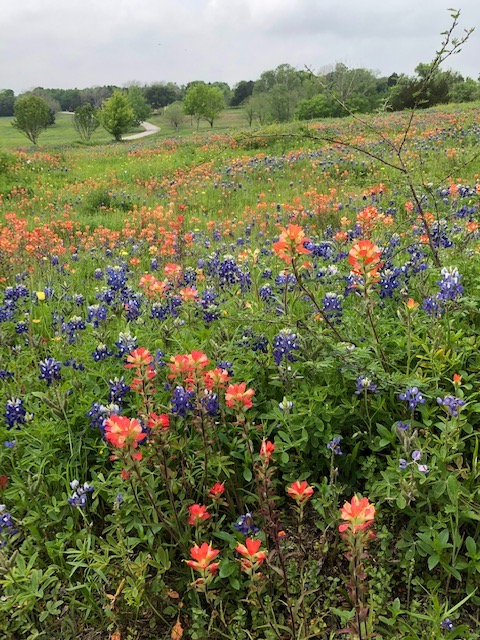
Like thousands of others, we’ve gone, of course, to see the wildflowers.  For truly, not even an alpine meadow with a singing and twirling nun can rival the beauty of a springtime Texas rolling hill blanketed in bluebonnets, Indian Paintbrushes, and soon thereafter, Black-Eyed Susans.

But the journey is also a pilgrimage of sorts, or the very least, our version of the “Trip to Bounty.”  For though I never actually lived there, the little town of Chappell Hill, Texas, named for some of my forebears, has a strong ancestral pull on me, if only for the fact that it’s the one place on earth where I don’t have to actually spell out my name for others to get it right.

What’s more, we’ve gone not just to reconnect with a family spot, but to renew our relationship with nature itself.  For there is something downright healing about simply breathing in the fresh air, gazing on blue-flowered hillsides that look like pools of water, and remembering that man may have made the cities, but God made the country indeed.

Fortunately, we have taken enough pictures of bluebonnets—with and without various children, grandkids, and other family members sitting in the midst of them—to remind us of what we’re missing.  More than just that, however, even without making our annual pilgrimage, I know that the flowers are there.

Coronavirus or not, those bluebonnets, or more specifically, the lupinus texensis, are still pushing their petals upward, resembling the bonnets wore by the pioneer women who long ago saw them.

Those Indian paintbrushes or castilleja, notoriously unpredictable each year, are still flushed with selenium that some found to be an effective treatment for rheumatism and the Ojibwe tribe used to make their hair glossy and full bodied. (Too late for some of us.)

And those rudbeckia hirta, daisy-like with a dark center, will continue to lend their cheerful contribution to the explosion of colors that come when the winter is finally done and summer is knocking on the doors.

All of which is enough to remind me that even when I can’t see Him, God is at work in this world.  And for every virus there is a vine somewhere blooming on a hillside, despite the blight that may be elsewhere.  For every opportunity lost to this season of solitude there will be a new one waiting in the future.  And for every stressful situation knowing that God is in control can give us a peace that can surpass even our ability to understand and to comprehend what’s happening to us.

I’ll miss the trip.  But whether I gaze on them or not, I am grateful that those wildflowers will still bear a magnificent witness to the glory of God, not just in Chappell Hill but all across Texas and other places as well.

Here’s hoping I can do the same.Wildflowers

Posted in Uncategorized | 6 Comments