COVID Contemplations (May 12) – “Following the Leader”

Walking with our grandkids along a local trail  on Saturday I saw it:  an inspiring quotation on a granite marker from Ralph Waldo Emerson, the 19th century American essayist and naturalist, which read simply:

“Do not follow where the path may lead; go instead where there is no path and leave a trail.”

The only problem is that Emerson never actually penned those words.  Nor were the words said by Robert Frost (who also gets the credit sometimes), though Frost did talk about that “road less traveled,” another quote that used to show up in graduation speeches this time of year back when we still had such ceremonies.

Instead, it appears to be a variation of the opening line of a poem written in 1903 by Muriel Strode whom you have probably never heard of, though some called her the “female Walt Whitman” of her time, a backhanded compliment to be sure.  Emerson didn’t falsely get credit for the phrase, in fact, until the 1990s, long after both he and Muriel had died.

Still, Muriel’s words are worth considering.  For these days would indeed seem to be a bit trail-blazing for all of us.  And as we inch our way forward to new patterns of social interaction, there truly are a lot of open-ended questions to answer:

Will people ever shake hands again?

When can we responsibly re-open the church to meet both the safety and spiritual needs of folks?

What metrics should we watch, and which measures should we take, as we make this decision? 

And most of all, will we ever be able to have donuts and coffee in church again?

Going where there is no path is harder than one might think, it seems.  But the good news is that we never actually have to go alone.  For long ago, Jesus told one of His disciples who was similarly in a time of great confusion, “I am the Way, the Truth, and the Life,” and so He is.

It all reminds me a little of being in the backcountry of Kenya many years ago with a pastor who was taking us to see a particular church.  As we literally “bushwhacked” our way through the jungle in his small car, I couldn’t help but notice that there didn’t seem to be a road we were following at all.  And when I asked him where we were on the map, he simply smiled and said, “Here, brother, I am the map.

The way ahead may be similarly unmarked for all of us.  But how good it is to be reminded that the One who is driving actually knows the way.   For even with uncertain days ahead, one thing is clear:  Jesus has already gone before us, and He’s left a trail for us to follow as well.

No matter who actually said it first.
Posted in Uncategorized | 2 Comments

COVID Contemplations (May 11) – “Wild Blue Yonder”

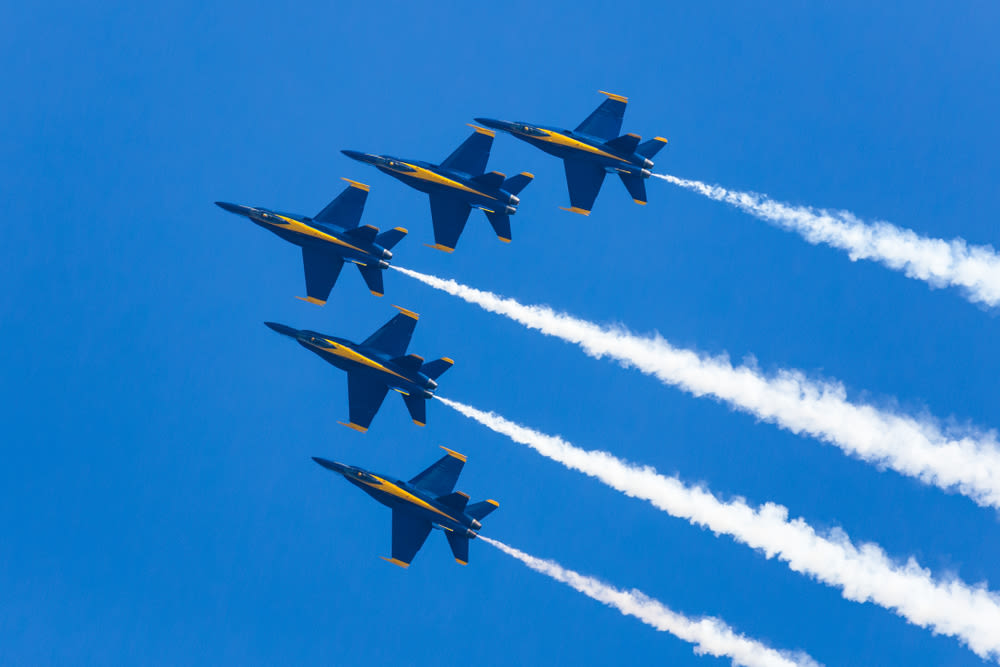
Things are looking up.  Or at least I have been doing a lot of it over the past week.  For on Wednesday, we parked outside the mall to watch as the famed U.S. Navy Blue Angels did a flyover saluting health care workers in Houston.   Then on Sunday afternoon, thanks to a tip-off from a friend, we perched in another parking lot to get a view of some of the nearly 30 vintage aircraft from the Lone Star Flight Museum that soared through the skies to commemorate all those heroes who bravely sacrificed to end the Second World War seventy-five years ago.

You could hear the difference, of course.  For those historic planes, including B-25 bombers and P-51 Mustangs, thundered loudly overhead, and from below you could practically see their propellers wildly spinning.  On the other hand, the F/A-18s flown by the Blue Angels quickly roared through the blue skies, going so fast that the sound barely had time to reach where we stood below.

In either case, however, the flyovers had the same desired effect on all those who saw them:  awe and encouragement.  And maybe that’s why all throughout the Bible we are told to lift up our eyes and look to the heavens whenever we are confused or anxious.  For when we take our eyes off of the circumstances around us, we are reminded that there is a much wider world beyond whatever may be our immediate focus.

The psalmist put it this way, for instance, telling those pilgrims on their way to Jerusalem to lift up their eyes to the hills. (Psalm 121) But then he asks, “From where does my help come?”  For, you see, it was not the hills themselves, filled with statues of idols and pagan altars, but the Lord of the higher heavens who is our helper and keeper.

Likewise, Jesus Himself told His disciples in Luke 21 to watch for “the Son of Man coming in a cloud with power and great glory” one day.  Or as an old country-western hymn used to put it, “keep your eyes upon the eastern sky, lift up your head, redemption draweth nigh!”

That’s why cathedrals and places such as Christ Church were built with such high ceilings and lofty angles, with stained glass filtering the sun’s rays in all kinds of colors, in fact:  they were meant to draw our eyes upward.  For when we do just that, we may find that our spirits too have been lifted.

Keep looking up, friends. For you never know what you may find in the heavens.  You may even discover that not all angels are blue.

Posted in Uncategorized | Leave a comment

COVID Contemplations (May 8) – “Zoom, Zoom!”

It all apparently started when Eric Yuan was a freshman studying applied math and computer science at one university in China and his girlfriend (now his wife) was at a college that was a ten-hour train ride away.  They tried long-distance dating, of course, but Eric dreamed instead of a handheld device that would enable two people to see and speak with each other from anywhere in the world.  The problem was that Eric knew that China was still at least ten years behind America in having the resources to develop such an idea.

So after hearing a speech by Bill Gates, Eric applied for a visa to travel to the United States.  American consular officials denied that visa eight times.  Until finally, at the age of 27, and speaking almost no English, Eric’s application was approved and he came to Silicon Valley in California to work for Webex, later a part of Cisco.  Cisco’s videoconferencing product was still not quite what he had envisioned, however, and so in 2011, he left that company, taking 40 engineers with him, to start his own.

Originally he called his enterprise Saasbee, which didn’t exactly bring the investors rolling in. He received so many rejections for funding, in fact, that he changed his screen saver to read “It Can’t Be Done” and then kept on working anyway. Until, after renaming his company Zoom, Eric was able to launch a beta version of his program in 2012 that could host 15 video participants, signing Stanford University as its first customer.  By the end of its first month, the number of users grew to 400,000 and by 2013, over one million.

Today, of course, the pandemic has made Zoom a regular feature of many people’s lives, with over 300 million daily participants, up from 10 million in December before the virus hit.  And that English-challenged immigrant from 22 years ago is now worth almost $7 billion.  But Eric still takes the time to answer complaints and concerns that folks may have with his product, working 18-hour days and writing the code himself if necessary to resolve whatever issue may arise.

All of which is a reminder that even as a world-stopping epidemic is believed to have come out of China five months ago, nine years earlier an inventor with a better idea to allow individuals, schools, and businesses to keep on communicating face-to-face did so as well.  And the brainchild of Eric Yuan, a believer in Christ, has been used not just to facilitate corporate communications but to bring healthcare to rural settings around the world, as well as education to students who couldn’t make it to school even if it was still meeting.

To be honest, I’m probably not alone in getting a little tired of all the Zoom meetings I now attend.  Until I remember anew, while conversing simultaneously with other church leaders from Africa to Russia to the Philippines, just what an incredible technological marvel that program is and see it as a provision of God that came to pass before we even knew we needed it.  For as Deuteronomy 31.8 reminds us, “The Lord is the one who goes ahead of you.”

I still miss the in-person contact with others, of course.  But Eric Yuan says they are working on developing a virtual hug that you can actually feel.  And given his motto for life, “Hard Work and Stay Humble,” I won’t be all that surprised if he pulls that off as well one day.

Posted in Uncategorized | Leave a comment

COVID Contemplations (May 7) – “Pray Day! Pray Day!”

It was 97 years ago that the term first found its way into English. For when its engines failed while traveling between England and France, a Royal Airforce “flying boat” in 1923 frantically radioed out the call to operators on both sides of the channel using the French words for “help me,” “m’aidez.”  And in turn, English speaking radio operators heard it phonetically as simply “May Day.”

It didn’t take long, however, for the new phrase to spread, reaching as far away as Singapore in a matter of months.  For although the previous codeword, “S.O.S.,” with its pattern of dots and dashes (…—…) was simple to recognize and remember, to the listening ear “S” was too easy to mistake for “F” and planes needed something else.  “May Day” worked and accordingly, in 1927 the United States formally adopted the phrase as an official radiotelegraph distress signal.

In the current pandemic, however, we might well think of a similar phrase, particularly on this National Day of Prayer, first proclaimed by President Harry Truman in 1952.  For confronted with the uncertainty of a disease we cannot cure, we might suggest that this is indeed a “Pray Day.”

Some have said in recent months, of course, that “thoughts and prayers” are an inadequate way to respond when life goes wrong and innocents are hurt.  But in truth, people of faith have always turned to prayer when facing trials and uncertainty.  And even while we still cannot gather together in our sanctuary, we can yet meet at the foot of the cross to boldly approach the throne of grace.  For as this year’s proclamation reminds us, “no problem is too big for God to handle.”

Before the day is over, thus, take a moment to join in a prayer such as this one:

“O Lord, our God:  You are greater than any pandemic and no disease can separate us from You. For even when the darkness comes, Your light still shines…even when the shadows fall across our way, You still walk with us…and even when we don’t know what the future holds, we know that You hold the future.

So may all those who have been affected by this virus find their healing and strength in You.  May this, Your world, find its hope in You, our Creator.  And may each of us be Your agents this day to counter the cries of fear and proclaim instead the power of Your love, which casts out all fear.

Come, Lord, for we, Your children, need You.

Come into this world that all may know You are God.

Heal the hurt. Flatten the curve.  Turn the tide. Bring us together.

And grant us Your peace.

In the name of Christ we pray, Amen.”

Posted in Uncategorized | 4 Comments

COVID Contemplations (May 6) – “Bubblin’ Over”

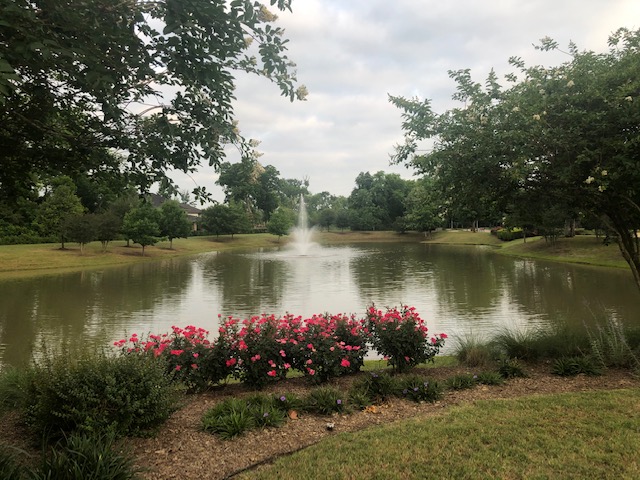
Technically it’s a retention pond, I know, the kind that developers are required to put in place to offset the loss of land that they use to build homes or hard surfaces on.  For without such mitigation efforts, stormwater has no place to run off.  And that, in turn, can cause erosion, transfer pollutants and chemicals into nearby water bodies, and most significantly, produce flooding, an ever- present possibility in an area that is known for having three five hundred-year floods in three years.

Beyond just their utilitarian value, however, those ponds are also beautifully landscaped (if plainly little) lakes which not only offer an aesthetic appeal but actually increase biodiversity and even provide habitats for all kinds of animals and organisms, including alligators.  What I discovered while we were walking early this morning, however, is that there’s an obvious difference in what those ponds look like when the aerator fountains are turned on and when they are not.

When running, for instance, the fountains in the middle produce actual waves in the water, shooting as high as forty feet with a flow rate of almost 100 gallons per minute.  But before the fountains turn on what you may see instead is simply a murky mess, looking for all the world like just a low spot in the land after a thunderstorm.

All of which is simply the difference between still water and what the Bible frequently refers to as “living water.”  For living water not only is flowing and moving, but it’s also the source of life.  Jeremiah describes God, for instance, as “the spring of living water” (Jeremiah 2.13 and 17.13) and Zechariah even prophesies that one day those waters will flow from the Temple in Jerusalem all the way to the Dead Sea, bringing new life to that lake which now has none.

Likewise, Jesus once told a Samaritan woman whom he encountered at Jacob’s Well in Sychar that He could give her “living water” and she would never thirst again. (John 4.10) Or in short, what makes water living is that it brings life to others.  And in a similar way we are called to be dispensers of that same wonderful drink to those all around us.  But to do so, we need not just a “spring” in our step but a willingness as well to let God’s love overflow through us to others.

If you’ve been stuck in nothing more than a puddle of late, perhaps it’s time thus to ask Jesus to bring His living water into your life too.  For as I once heard some sweet Jamaican children sing, “Jesus’ love is a bubblin’ over.”

May it bubble in your life and mine.

Posted in Uncategorized | Leave a comment

COVID Contemplations (May 5) – “What Are We Celebrating Again?”

All in all, it’s pretty much a day like any other.  Indeed, it’s not even a federal holiday, so in most of the country places like banks and stores remain open, unless they are closed because of the pandemic.  But in the state where it occurred, folks still remember the battle—however brief it was– that took place some 158 years ago today.

Like much of what happens in the world, it initially at least had to do with money, beginning when the newly elected president of Mexico, facing national financial ruin, was forced to default on debt payments to foreign governments.  In response, three European powers sent their naval forces to demand repayment, with two of them, Britain and Spain, quickly able to negotiate and withdraw.

But France, looking for a new empire, decided to use the opportunity to try to seize power as well.  Sending a well-trained army of 6,000 troops that landed at Veracruz, the French forced the Mexican president to flee to a new headquarters in the north.

In turn, the Mexican leader rounded up all the help he could find, assembling a rather rag-tag and poorly equipped army only one-third the size of the invading force.  Fortunately, however—if you’ll forgive my native brag—they were led by a Texas-born general named Ignacio Zaragoza.

Incredibly enough, then, when the French arrived to attack the small town of Puebla de Los Angeles where the Mexicans were taking their stand, the battle lasted only from daybreak to early evening.  But when it was all over, almost 500 French soldiers had been lost compared to fewer than 100 Mexicans.

To be certain, the fight against the French in Mexico lasted five more years and most historians will tell you that the Battle of Puebla on May 5, 1862, was not at all a major strategic win.  But Zaragoza’s success there was nonetheless the symbolic victory that bolstered Mexican resistance until the French were eventually driven out completely.  And often times, it’s the small battles in our lives that can do the same.

The questions we should ask therefore are simple:  will we allow our circumstances, whatever they may be, to overwhelm us?  Will we give in to the kind of pessimism that spreads like a pandemic if we don’t stop it?  And will we go on fighting when our cause is just, even if the odds are three to one against us?  After all, it was the trumpet section of the marching band that brought down the walls of Jericho, and a young shepherd boy who pulled off the most unlikely of all victories against a far larger warrior. It’s no wonder thus that Jesus said that we only need to have faith like a grain of mustard seed to move a mountain (Matthew 17.20).

Of course, Cinco de Mayo, or the fifth of May, has now become a cultural celebration of all things Mexican.  And ironically, it’s observed far more in the United States than in the country where the battle of that day actually took place. However you may celebrate it, though, perhaps today is a time to give thanks for the small triumphs in life as well as the huge ones, and for the grace of God which really can move the mountains in our lives.

Just in queso you’ve forgotten that.

Posted in Uncategorized | 4 Comments

COVID Contemplations (May 4) – “Sampling Salvation”

I miss the free samples.  For as nice as it was to once again wander through the Costco warehouse a few days ago (at a special time, no less, set aside for those of us who are, like some of their cheddars, more mature in life), it just isn’t the same without also being able to migrate between those little tables in the aisles, grazing unashamedly on all kinds of things from chicken to chips, juices to junk food.

For in addition to being free, those sample stations offer the opportunity to try something that you might never on your own be tempted to actually buy.  What’s more, though you may feign a little interest in whatever it is you’re sampling, just to be polite—“what an interesting flavor combination; I’ve never had bacon and peanut butter before”— there’s not any real obligation to even like it.  And how often do you have that chance in life?

Doesn’t it seem, for instance, that far too frequently our interchanges with others are almost rote and pre-rehearsed, lacking in any real authenticity or honesty?  For indeed, long before the coronavirus pandemic arrived, most of us already knew how to politely “distance” ourselves from those around us with whom we might not agree in life.  But I wonder if in doing so we may have missed a good opportunity to make a witness for Christ to others.

Writing to one of his young friends in this regard, St. Paul encouraged Titus to show himself “in all respects to be a model of good works,” demonstrating both integrity and dignity in his teaching. (Titus 2.7) And the good apostle similarly admonished the Ephesians to become “imitators of God as beloved children,” walking in love as Christ loved us, “a fragrant offering” to God. (Ephesians 5.1-2).

As those who believe, thus, we’re called to offer enticing samples of what salvation actually looks like to those who may not yet know what God can do in their lives.  And that will play itself out in numerous ways—how we drive, how we deal with others, how we tip, how we pray, and even, the look on our faces when things may not go well for us.  For if we are crabby and not cheerful, selfish and not focused on others, with the countenance of a mule and not of the Master, our witness will not be a winsome one at all.

What’s more, as this odd moment in our shared lives has worn on, some of the social lubricants such as manners that keep folks from rubbing too harshly against one another have begun to dry out, with tempers starting to flare, abuse cases rising, and self-destructive habits increasing dramatically. Now then would seem to be the ideal time to so walk in love that others are drawn in by the sweet fragrance of faith, just lingering on us.

Or in other words, more grace is exactly what this weary world needs right now, and if we are not the ones to sample it to others, who will?

Did I mention, by the way, that it’s absolutely free?

Posted in Uncategorized | 3 Comments

COVID Contemplations (May 1) – “One Foot At a Time, Sweet Jesus”

I have to admit that I was little anxious about April, though it had nothing to do with the coronavirus or the curious conditions under which we’ve all been living lately.  Rather, my watch, which doubles as a sometimes rather unreasonable personal trainer, told me at the beginning of the month that my challenge was to walk 210.8 miles, or seven miles a day.  And that seemed to go beyond being a smart watch to being a smart-alecky one.

Still, I dutifully started the month and managed to maintain the pace, even getting ahead by three or four miles on the running total.  And in turn, I actually ended up meeting the goal a day early somehow, despite the faulty calculation on the program that kept trying to divide the month of April into 31 days.

What I have figured out, however, reinforced by the past 21 months or 654 days of walking, is that you have to approach it simply one step—or perhaps I should say, one plodding step—at a time.  Left.  Now Right. Now Left Again. Now Right Again. Or in short, it’s not just “One Day at a Time, Sweet Jesus,” it’s more accurately, “one foot at a time.” Which would seem to be an apt piece of advice as well for how to get through a pandemic period, and beyond that, how to navigate the Christian life as a whole.

Think of it like that manna in the wilderness if you will.  For as the Hebrews who had come out of Egypt wandered somewhere in the Sinai, Exodus 16.4 records that God said to Moses, “I will rain down bread from heaven for you,” though it turned out to be “thin flakes like frost on the ground”(verse 14) and not exactly an artisan loaf.  It probably got pretty old pretty fast.  But they had to admit that it kept them alive.

The catch was, however, that the manna wouldn’t keep overnight without spoiling, and so those Israelites were dependent upon God every morning for their “daily bread.”  And that seems to be the general rhythm God built into this world.  For if we can learn how to take life one day at a time, enjoying God’s mercies which are “new every morning,” we can slowly but surely whittle away at what may seem like looming goals and impossible tasks indeed.

Today begins another month in this pandemic and though we seem to be moving away from the worst perhaps, we’re still a rather long distance from anything that looks like normal, or at least what normal was just four months ago.  But today is also the day that the Lord has made, and so I am choosing to be glad in it.

To be sure, I suspect that my watch is not going to go easy on me when I get up the courage to see what the “May Challenge” is.  But whatever it tells me, I’ll give it a shot.

Just as long as I can go one foot at a time.

Posted in Uncategorized | 2 Comments

COVID Contemplations (April 30) – “I’ve Got My Eyes on You”

We could easily have understood if he had panicked a bit at his circumstances.  For by the time that word reached him in Jerusalem, the invaders had already come across the Dead Sea and arrived at the oasis of En Gedi, only 25 miles or so southwest of the city.  What’s more, it was not just one army coming against him, but three.

Each of them had their reasons, of course.  The Moabites were tired of paying an annual tribute of sheep and wool to Israel, and the Ammonites had been restless ever since David’s general had conquered them.  We know very little about the third member of that Transjordan Coalition, the “Meunites,” but they lived somewhere along a mountain range near Edom.  More to the point, however, is that when assembled together, those three enemies of Israel possessed an overwhelming superiority in forces indeed.

So according to 2 Chronicles 20, Jehosophat, the king of Judah, facing a life-threatening crisis and confronted with a decided numerical disadvantage, had nowhere else to look except to God.  And so his prayer was a simple one, expressed in verse 12 of that chapter:  “For we have no power to face this vast army that is attacking us.  We do not know what to do, but our eyes are on you.”

And as Louie Giglio has thoughtfully observed in a recent article in Christianity Today, “every leader around the globe is in a similar predicament…faced with the three-pronged advance of a global health pandemic, a world economy that’s come to a screeching halt, and the personal crisis of anxiety and fear.”

It might be pretty easy for us to panic a bit too, thus.  For especially when the way forward is not obvious to us, the default response for many is to go a little negative or pessimistic.  But look instead at how Jehosophat responded to his circumstances.  According to verse 20, as Giglio points out, the good king did three things, in fact, that made a difference:  He set out in faith, He stood up in boldness, and he spoke out a word of encouragement:  “Have faith in the LORD your God and you will be upheld.”

What happened next no one can really explain. For as soon as the Israelites began to sing God’s praises, the invading armies–perhaps given a vision of God’s unseen heavenly forces– became so confused and terrified that they actually attacked each other, and Judah never had to fight at all.  It took them three days just to pick up the spoils, in fact, and when they got back to Jerusalem it was clear indeed that the battle had been the Lord’s.

And as we cautiously move forward into still uncertain days, waging our own battles against disease and discouragement, it is the same for us as well.  For when you don’t know what to do, it’s never a bad strategy at all to simply put your eyes on God…and keep them there.

Posted in Uncategorized | Leave a comment

COVID Contemplations (April 29) – “Behind the Mask”

I saw it recently on my favorite Christian satire website, The Babylon Bee, and it made me laugh.  For the headline said simply:  “Mysterious Masked Man Fights Off Masked Men to Save Masked Man.”  The “fake news” story then went on to report that “an unknown masked man was attacked by a group of masked men, but he was saved when a mysterious masked man fought off the attackers,” leading a masked bystander to ask the obvious question, of course:  “Who was that masked man?”

And as we’ve now been encouraged to wear masks in public at all times, I suspect that as the days unfold, some of us may be asking that same question, as well.  For notwithstanding the fashion accessories now beginning to “bling up” some home-made masks, when people’s faces are covered it can be hard indeed to know just exactly who someone is.

Though hiding behind a mask may make good sense in a pandemic, however—or if you happen to be, say, Darth Vader– it’s no way to live as a person of integrity whose behavior and even facial expressions should reflect the presence of God in our lives.  For as 2 Timothy 2.15 reminds us, those who follow Jesus are intended to be workers who have “no need to be ashamed.”

To be sure, masks can help us hide our true thoughts and feelings and even offer an illusion perhaps of anonymity.  Likewise, masks are usually easy to don, though they are often far more difficult to take off.  But the truth is that we can’t enjoy healthy relationships unless we show others who we actually are.  Instead, as Eugene Peterson paraphrased 2 Corinthians 4.2, “we refuse to wear masks and play games… Rather, we keep everything we do and say out in the open, the whole truth on display, so that those who want to can see and judge for themselves in the presence of God.”

Or in other words, even if we wear a facial covering for health reasons, we’re still called to live the same way behind our masks as without them, being honest and open with all whom we encounter.  For when it comes to making a witness for Christ, to say nothing of entering into a genuine relationship with someone, as C.S. Lewis once asked the question, “How can they meet us face to face till we have faces?”

And just in case you were wondering… having been made in His image, I’m pretty certain God has seen exactly who we are and what we look like.  And incredibly enough, He loves us completely anyway.


Posted in Uncategorized | 1 Comment